Mon–Fri 9am – 5pm

Menu
Apartment Cleaning Contracts: What Property Owners Need to Know Before Signing
22 Aug 2026
Table of Contents
- Apartment Cleaning Contracts: What Property Owners Need to Know Before Signing
- What Is an Apartment Cleaning Contract?
- Why Apartment Cleaning Contracts Are Different From Commercial Cleaning Contracts
- Why Property Owners Are Struggling to Manage Cleaning Vendors Right Now
- How a Well-Structured Cleaning Contract Improves Outcomes
- Core Components of a High-Performing Apartment Cleaning Contract
- Metrics That Matter: How to Measure ROI on a Cleaning Contract
- Common Mistakes Property Owners Make When Signing Cleaning Contracts
- How to Choose the Right Cleaning Contract Partner
- FAQ
- Conclusion
Apartment Cleaning Contracts: What Property Owners Need to Know Before Signing
Apartment cleaning contracts govern one of the least glamorous but most consequential line items in a property's operating budget. Get the scope wrong and you're paying for work nobody agreed to, chasing a vendor who won't return calls, or explaining to residents why the hallway carpets haven't been touched in a month. This guide breaks down what belongs in an apartment cleaning contract, how it differs from a standard commercial cleaning contract, and what to check before you sign.

What Is an Apartment Cleaning Contract?
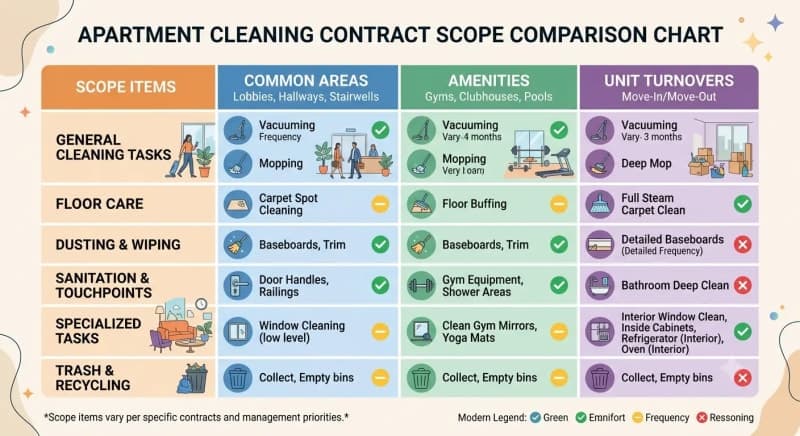
An apartment cleaning contract is a written agreement between a property owner or management company and a cleaning vendor, defining the scope, frequency, and price of recurring cleaning services for common areas, amenity spaces, and sometimes individual unit turnovers. Unlike a one-time cleaning invoice, it sets recurring obligations — usually monthly or annually — with renewal terms, cancellation clauses, and performance expectations spelled out in writing.
Most apartment cleaning contracts cover:
Common areas — lobbies, hallways, stairwells, elevators, mailrooms
Amenity spaces — fitness centers, clubhouses, pools, business centers
Unit turnover cleaning — deep cleans between tenants, often billed per unit rather than on the recurring schedule
Exterior touchpoints — entryways, trash chutes, parking structures
A well-written contract also names who handles supply restocking, who's liable for damage, and how disputes over missed cleanings get resolved.
Why Apartment Cleaning Contracts Are Different From Commercial Cleaning Contracts
Commercial cleaning contracts for offices are built around a single tenant's business hours and a relatively stable occupied footprint. Apartment cleaning contracts have to account for constant turnover, resident complaints, and spaces that never fully close. A hallway gets used at 2 a.m. the same as it does at 2 p.m., and a vendor who only shows up during weekday business hours — standard practice for office cleaning contracts — will miss the traffic patterns that actually drive wear and complaints in a residential building.
There are three structural differences worth naming:
Scheduling — apartment work often runs early morning or split shifts to avoid resident foot traffic, while office cleaning contracts typically run after-hours.
Scope volatility — unit turnovers fluctuate month to month with lease cycles, so the contract needs a separate per-unit rate rather than a flat monthly number.
Accountability — residents, not a single facilities director, are often the ones reporting problems, so the contract should specify a response-time clause for complaints.
"Service provision is typically governed by long-term commercial cleaning contracts and detailed service level agreements, especially in industrial cleaning services and retail space maintenance" — Technavio Research
Why Property Owners Are Struggling to Manage Cleaning Vendors Right Now
Multifamily operators are dealing with tighter budgets and higher resident expectations at the same time, which puts pressure on both sides of the cleaning contract. Vendor turnover is common because independent janitorial operators are underpricing bids to win the work, then cutting labor hours mid-contract to protect margin. That leaves property managers re-bidding the same building every 12 to 18 months instead of building a stable vendor relationship.
The broader cleaning services market is growing fast, which is part of the problem. Industry research from IBISWorld puts the U.S. commercial cleaning and sanitation services market at roughly $75 billion, and multiple market analysts project continued mid-single-digit annual growth into the next decade. More demand has pulled in more vendors — including operators with no experience pricing recurring residential contracts — which makes it harder to tell a serious operator from someone bidding low to build a portfolio.
How a Well-Structured Cleaning Contract Improves Outcomes
A contract that spells out scope, frequency, and accountability in specific terms does two things: it protects the owner from scope creep and vague billing, and it protects the vendor from unrealistic expectations that weren't part of the original bid.
The Cost of a Vague Contract vs. a Detailed One
A vague apartment cleaning contract — "clean common areas as needed" — invites disagreement the first time a resident complains. A detailed contract defines frequency by area, names the cleaning method, and states a response window for reported issues. The upfront cost of writing a tighter scope is a few extra hours of planning. The downside of skipping it shows up later: disputed invoices, missed cleanings blamed on miscommunication, and a vendor relationship that ends in a rebid within a year.
What a Properly Scoped Contract Actually Includes
At minimum, a solid apartment cleaning contract should specify:
Exact areas covered, listed by name, not by category
Cleaning frequency per area (daily, weekly, per turnover)
Products and equipment the vendor is responsible for supplying
Staffing levels and whether a supervisor does periodic quality checks
A termination clause with a defined notice period (30 to 60 days is standard)
Insurance and bonding requirements, verified before signing, not after
Core Components of a High-Performing Apartment Cleaning Contract
Beyond scope and frequency, the contracts that hold up over multiple renewal cycles tend to share a few features:
A fixed base rate plus a documented per-unit turnover rate, so seasonal leasing swings don't create billing disputes.
A quality control clause naming who inspects the work and how often.
A communication protocol — a single point of contact on both sides, with a stated response time for complaints (24 to 48 hours is common).
An annual price review clause tied to a transparent factor like minimum wage changes or a published cost index, rather than an open-ended increase at the vendor's discretion.
Property owners who are outsourcing vendor sourcing entirely sometimes work with a commercial cleaning appointment setting partner to pre-qualify bidders before a walkthrough, which cuts down on the number of unqualified proposals that make it to the comparison stage.
Metrics That Matter: How to Measure ROI on a Cleaning Contract
Cost per square foot is the number most owners default to, but it's an incomplete measure on its own. A cheaper rate that comes with missed cleanings, resident complaints, and a mid-contract vendor exit costs more in staff time and reputation than a slightly higher rate that holds steady.
Track these instead:
Owners managing multiple properties sometimes bring in a B2B cleaning sales outsourcing partner specifically to standardize these metrics across a portfolio, so every building is judged against the same benchmarks instead of whatever the on-site manager happens to track.

Common Mistakes Property Owners Make When Signing Cleaning Contracts
Comparing bids on price alone without confirming each vendor priced the same scope of work.
Skipping the walkthrough and pricing off a written scope document, which leads to disputes once the vendor sees the actual building.
No defined per-unit turnover rate, which turns every lease-up season into a billing argument.
No termination clause, which locks an owner into a underperforming vendor for the full contract term.
Not verifying insurance and bonding before signing, then discovering a coverage gap after an incident.
How to Choose the Right Cleaning Contract Partner
If you're building your first vendor shortlist rather than comparing bids you already have in hand, a janitorial lead generation for multifamily properties partner can source and pre-screen candidates before you run a formal RFP. Either way, use this checklist before signing any apartment cleaning contract:
Confirm scope alignment. Every bidder should be pricing the identical list of areas and frequencies — not their own interpretation of "common area cleaning."
Request references from similar properties. A vendor who cleans small commercial offices under office cleaning contracts may not have residential-scale staffing.
Verify insurance, bonding, and worker screening. Ask for a current Certificate of Insurance, not a promise to provide one later.
Review the termination and renewal terms before the pricing terms — a great rate with no exit clause is a liability.
Ask how quality is measured, and whether that measurement is written into the contract or just verbal.
Check the escalation path for missed cleanings — who gets notified, and what happens if it's not resolved.
According to ISSA's guidance on property management RFPs, a standardized bid process — where every vendor answers the same operational questions against the same building information — is what actually separates serious operators from vendors who are just good at sales presentations.
FAQ
What should an apartment cleaning contract include?
It should list every area covered by name, the cleaning frequency for each, the per-unit turnover rate, staffing details, insurance requirements, and a termination clause with a defined notice period.
How much do apartment cleaning contracts typically cost?
Pricing varies widely by market, unit count, and scope, typically combining a fixed monthly rate for common areas with a separate per-unit charge for turnover cleaning. Get at least three bids against the identical scope document before comparing numbers.
How is an apartment cleaning contract different from an office cleaning contract?
Apartment contracts account for 24-hour occupancy, resident complaints, and fluctuating unit turnover volume, while office cleaning contracts are built around fixed business hours and a stable, single-tenant footprint.
How long should an apartment cleaning contract term run?
One year is standard, with a 30- to 60-day termination clause so either party can exit if the relationship isn't working, without waiting out a multi-year commitment.
What's the biggest mistake owners make when comparing cleaning contracts?
Comparing final price without confirming every bidder priced the same scope. A lower number often means a smaller scope, not a better deal.
Do apartment cleaning contracts cover unit turnovers or just common areas?
Both, usually as separate line items — a flat monthly rate for common-area cleaning and a per-unit rate for turnover cleaning tied to lease-up volume.
Conclusion
An apartment cleaning contract is only as good as the scope document behind it. Owners who define areas, frequency, and accountability in specific terms — and who compare vendors against that same document — end up with contracts that renew instead of contracts that get rebid every year. If you're evaluating vendors right now, start with the checklist above before you look at a single price quote.
Connect With Us
Have questions? Want to learn more? Reach out to us on WhatsApp or follow us on Facebook for updates and tips.


