Mon–Fri 9am – 5pm

Menu
Commercial Cleaning Contracts: The Complete Guide (With a Free Commercial Cleaning Calculator)
Last updated:
20 Aug 2026
Table of Contents
- Commercial Cleaning Contracts: The Complete Guide (With a Free Commercial Cleaning Calculator)
- What Is a Commercial Cleaning Contract?
- Why Do Cleaning Contracts Vary So Much in Price?
- How Does a Commercial Cleaning Calculator Help You Price Contracts Accurately?
- What Are the Core Components of a Strong Commercial Cleaning Contract?
- How Do You Find Reliable Commercial Cleaning Contracts Near Me?
- What Mistakes Do Facility Managers and Cleaning Companies Make When Signing Contracts?
- Self-Calculated Estimate vs. Professional Contract Quote
- How to Choose the Right Commercial Cleaning Contract Template
- Frequently Asked Questions
- Get a Real Number Before You Sign
Commercial Cleaning Contracts: The Complete Guide (With a Free Commercial Cleaning Calculator)
Quick Answer: A commercial cleaning contract is a written agreement that defines cleaning scope, frequency, pricing, and performance standards between a facility and a cleaning provider. Most contracts price out between $0.07 and $0.25 per square foot for standard recurring office cleaning, or $25 to $75 per hour per cleaner, depending on facility type and region. A commercial cleaning calculator turns your square footage, service frequency, and facility type into an accurate baseline price before you ever sign or send a bid. Getting the scope of work, pricing method, and service level agreement right up front is what prevents the disputes that cost facilities and providers real money later.
What Is a Commercial Cleaning Contract?
A commercial cleaning contract is a written agreement between a business or facility and a janitorial provider. It defines exactly what gets cleaned, how often, to what standard, and for what price.
A contract is not the same thing as a quote. A quote is a number. A contract is the document that says what that number actually buys — task list, frequency, quality standard, and what happens when something goes wrong.
Most commercial cleaning contracts run on one of three pricing structures: per-square-foot, hourly, or flat monthly rate. The pricing method you choose should match the predictability of the job — a stable office with a fixed footprint suits square-foot pricing, while a facility with variable hours or unpredictable mess suits hourly billing.
Why Do Cleaning Contracts Vary So Much in Price?
Two bids for the same building can look wildly different, and it's rarely because one provider is padding their margin. Facility type, cleaning frequency, and scope definition drive most of the spread.
Standard offices typically fall at the low end of the range, while medical offices, restaurants, and industrial spaces run higher because of compliance requirements and heavier labor. A basic office might price around $0.08–$0.15 per square foot, while a medical facility can run $0.18–$0.30 per square foot for the same footprint, simply because of infection-control protocols and specialized supplies.
Location matters just as much as facility type. Labor costs in Northeast and West Coast metro markets run meaningfully higher than in Southern and Midwest markets, and that difference shows up directly in the quote — not because one provider is better, but because their labor line is bigger.
How Does a Commercial Cleaning Calculator Help You Price Contracts Accurately?
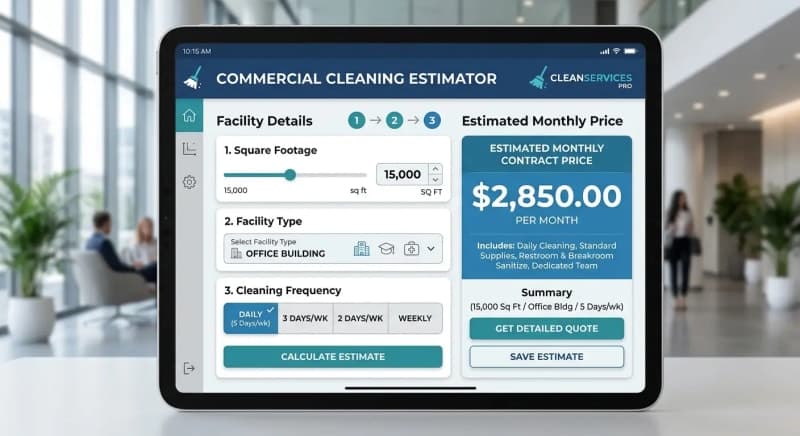
A commercial cleaning calculator takes the guesswork out of a first-pass number. You input square footage, facility type, cleaning frequency, and region, and it returns a price range grounded in current market rates — instead of a gut-check number pulled from memory or an outdated rate card.
For facility managers, a calculator is a sanity check against vendor bids: if three quotes come back and one is 40% below the calculator's range, that's a signal to ask what's being left out of scope, not a reason to celebrate the savings. For cleaning companies, a calculator keeps bids consistent across sales reps and prevents underpricing that erodes margin once labor and supply costs are actually accounted for.
Is Per-Square-Foot Pricing Better Than Hourly Pricing?
Neither method is universally better — each fits a different kind of job. Per-square-foot pricing works best for predictable, recurring cleaning where the space and task list don't change week to week, because both sides know the number in advance.
Hourly pricing works best for irregular jobs — post-construction cleanup, one-off deep cleans, or facilities where the scope genuinely shifts month to month. National averages run $25 to $75 per hour depending on region and specialization, according to multiple 2026 industry pricing guides.
What Should a Cleaning Contract Template Actually Include?
A usable cleaning contract template is more than a price line and a signature block. At minimum, it needs:
A detailed scope of work broken out by area and frequency (daily, weekly, monthly, quarterly).
Defined quality standards, not vague language like "maintain cleanliness" — specify what "clean" means for floors, glass, and restrooms.
A response-time SLA for reported issues, separate from the routine cleaning schedule.
Pricing terms and payment schedule, including what triggers a price adjustment.
Termination and renewal clauses, spelling out notice periods for either party.
What Are the Core Components of a Strong Commercial Cleaning Contract?
Beyond the basic template checklist above, a few components separate a contract that actually protects both sides from one that just looks official. Scope specificity is the single biggest predictor of whether a contract prevents disputes or causes them.
Contracts that say "clean restrooms daily" without defining what that means give both parties an argument and neither party a resolution. Contracts that reference an established quality standard — such as the ISSA Cleaning Industry Management Standard — give both sides a shared reference point when a dispute comes up.
"The average annual cost of unresolved service disagreements runs approximately $47,000 per affected facility once administrative time, re-service costs, and eventual re-procurement are factored in." — ISSA, Cleaning Industry Management Standard research
That single statistic is the strongest argument for spending an extra hour on scope language before signing anything. A vague contract is not a cheaper contract — it's a contract that defers its real cost to whichever side loses the eventual argument.
Response-time commitments deserve their own line, separate from the routine cleaning schedule. Industry benchmarking from BSCAI points to acknowledging a reported issue within two hours during service hours, with re-service inside four hours for routine complaints and two hours for anything health-relevant.
How Do You Find Reliable Commercial Cleaning Contracts Near Me?
Searching "commercial cleaning contracts near me" turns up dozens of providers, but proximity alone doesn't tell you who can actually perform. Vet on documentation first, price second — a provider who can't produce a certificate of insurance or a references list on request is a bigger risk than one whose quote is slightly higher.
Ask every local candidate for three things before comparing price: proof of general liability and workers' compensation coverage, at least two references from facilities similar in size to yours, and a written scope-of-work sample from a comparable existing account. A provider who hesitates on any of these three is telling you something about how they'll handle a dispute later.
Local route density also affects reliability more than most facility managers expect. A provider already servicing three buildings within a few blocks of yours has staffing depth and backup coverage that a provider driving in from across town typically doesn't.

What Mistakes Do Facility Managers and Cleaning Companies Make When Signing Contracts?
The most common mistake on the buyer side is comparing bids on price alone without normalizing scope. A lower number attached to a smaller task list isn't actually a lower price — it's a different job wearing the same contract format.
The most common mistake on the provider side is underpricing to win the account, then trying to claw margin back through scope-creep disputes later. That approach damages the relationship faster than losing the bid would have.
A few other recurring mistakes worth naming directly:
Signing a multi-year term without a price-adjustment clause, which leaves the provider absorbing rising labor costs or the client facing a mid-contract renegotiation.
Skipping the walkthrough and quoting from blueprints or square footage alone, which misses layout complexity that drives actual labor time.
Leaving supply and equipment costs undefined, so neither side is clear on who pays when a floor machine breaks or green-certified products are requested.
Self-Calculated Estimate vs. Professional Contract Quote
A commercial cleaning calculator and a professional quote aren't competing tools — they work in sequence. Use the calculator to set your expectations, then use a walkthrough-based quote to confirm or challenge that number.
How to Choose the Right Commercial Cleaning Contract Template
Not every template fits every facility. Before you adopt one, check it against this list:
Does it include a task list broken out by frequency, not a single vague cleaning description?
Does it define quality standards in measurable terms rather than subjective language?
Does it include a response-time SLA separate from the routine schedule?
Does it specify a termination notice period for both parties?
Does it include a price-adjustment mechanism for multi-year terms?
Does it list who supplies equipment and consumables?
Frequently Asked Questions
How much does a commercial cleaning contract cost per square foot?
Most standard recurring commercial cleaning contracts price between $0.07 and $0.25 per square foot, with the national average landing near $0.17. Medical, restaurant, and industrial facilities typically run higher due to compliance and labor intensity.
What should be included in a commercial cleaning contract template?
A usable template needs a detailed scope of work by frequency, defined quality standards, a response-time SLA, clear pricing and payment terms, and termination/renewal clauses. Missing any of these is what leads to disputes later.
How long should a commercial cleaning contract term run?
Terms typically run one to three years, often with an initial 30–90 day trial period. Longer terms should always include a price-adjustment clause tied to labor cost changes.
Can I negotiate a commercial cleaning contract price?
Yes — pricing, frequency, and scope are all negotiable, especially benchmarked against comparable local buildings. Providers are often more flexible on term length and payment terms than on the base rate itself.
Is per-square-foot or hourly pricing better for my facility?
Per-square-foot pricing suits stable, predictable spaces with a consistent task list. Hourly pricing suits irregular jobs like post-construction cleanup or facilities where scope shifts month to month.
What happens if a cleaning company doesn't meet the contract's scope of work?
A well-written contract specifies remediation steps: re-service timelines, credits for missed service, and grounds for termination. Without that language, a facility's only real option is an informal complaint with no enforceable resolution.
Get a Real Number Before You Sign
A commercial cleaning contract is only as good as the scope and pricing logic behind it. Whether you're a facility manager comparing bids or a cleaning company standardizing your quoting process, running the numbers through a commercial cleaning calculator before a walkthrough gives both sides a shared, defensible starting point.
Janitorial Appointment builds contract templates and pricing tools specifically for this stage of the process — before either side is locked into a number that doesn't match the actual scope. If you're ready to price your next contract accurately, start with the commercial cleaning appointment setting page to get a walkthrough on the calendar.
Connect With Us
Have questions? Want to learn more? Reach out to us on WhatsApp or follow us on Facebook for updates and tips.


