Mon–Fri 9am – 5pm

Menu
Cleaning Company Website Design That Books Walk-Throughs: The Complete Guide
26 Sep 2026
Table of Contents
- What Is Cleaning Company Website Design?
- Do Janitorial Businesses Really Need a Website to Win Commercial Contracts?
- What Should Commercial Cleaning Website Design Include?
- Which Pages Does a Janitorial Website Need?
- What Should the Homepage Say in the First Screen?
- How Is Janitorial Website Design Different From Residential Cleaning Sites?
- How Fast Should a Cleaning Business Website Load?
- How Do You Turn Website Visitors Into Booked Appointments?
- How Much Does Cleaning Business Website Design Cost?
- What Mistakes Do Cleaning Companies Make With Their Websites?
- How to Choose the Right Website Design Partner
- Frequently Asked Questions
- Conclusion: Build a Website That Supports Your Sales Pipeline
Effective cleaning company website design gives commercial buyers three things fast: proof of insurance and experience, a clear list of the facilities served, and a one-step way to request a walk-through. Follow three rules:
Write for facility managers and property managers, not homeowners.
Load the main content in under three seconds on mobile, because slow pages lose more than half of mobile visits.
End every page with one action, such as "Request a Free Walk-Through."
A site built this way works as a round-the-clock sales assistant for bids, renewals, and outbound outreach.
What Is Cleaning Company Website Design?
Cleaning company website design is the planning, layout, writing, and technical build of a website that turns searchers into qualified inquiries. It covers which pages exist, what each page says, how fast the site loads, and which buttons or forms capture a lead. Design here means how well the site sells, not only how it looks.
For a company that sells to offices, medical suites, warehouses, and schools, the website has a specific job. A facility manager rarely calls the first cleaning vendor found online. They check the site to confirm the company is real, insured, and experienced with buildings like theirs.
A commercial buyer wants references, scope details, insurance proof, and a low-risk way to start a conversation. A homeowner mostly wants a price and an open date. Good design puts the right answers in front of the right buyer without a search.
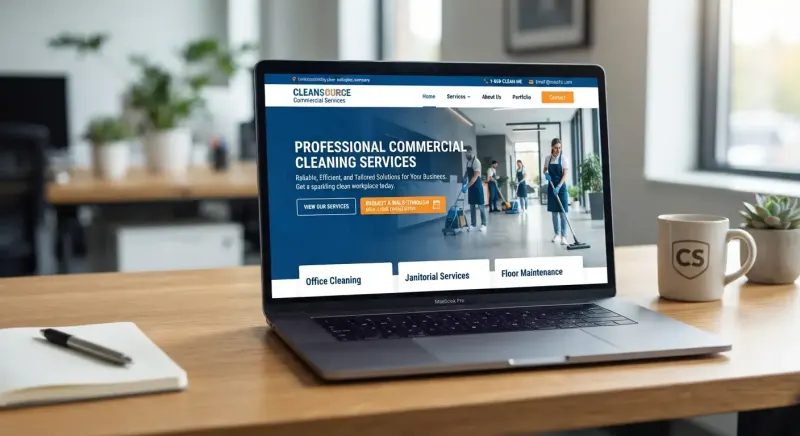
Do Janitorial Businesses Really Need a Website to Win Commercial Contracts?
Yes. Commercial buyers research vendors online before agreeing to a sales call, and a weak or missing site can remove a company from the shortlist. A single bid often involves a facility manager, a property manager, and sometimes a procurement contact. Each person may check the vendor's site independently before a walk-through gets scheduled.
Buyers spend only about 17% of a complex B2B purchase meeting with potential suppliers. With three suppliers in the running, each gets roughly 5% of buyer time, according to Gartner's B2B buying journey research.
For a cleaning contractor, most vendor evaluation happens while no salesperson is in the room. The website is the only representative present. A clear, credible site keeps the company on the list until the walk-through is booked.
Contract renewals and open bids raise the stakes. When a building's current provider slips, a manager may quietly compare three or four vendor websites in one afternoon. The site that answers insurance, references, and service scope quickly tends to get the call.
What Should Commercial Cleaning Website Design Include?
Commercial cleaning website design should answer a buyer's vetting questions in under a minute. Those questions are simple. Who are you, are you insured, do you clean buildings like mine, and what happens next?
Which Pages Does a Janitorial Website Need?
A janitorial site does not need dozens of pages. It needs the right seven:
Homepage: states who is served, where, and the next step.
Service pages by facility type: offices, medical, industrial, education, and retail each get their own page with a scope of work.
Service-area pages: one page per city or region, with real local detail.
About page: team, years in business, safety practices, and training.
Proof page: references, case studies, certifications such as ISSA's CIMS if held, and insurance and bonding details.
Contact page: built around a walk-through request, not a generic form.
Resource pages: short guides on contract costs, bid processes, and service frequency, which earn search traffic.
What Should the Homepage Say in the First Screen?
The first screen should state who the company serves, where, and what action to take. For example: "Commercial Cleaning for Phoenix Offices and Medical Facilities. Request a Free Walk-Through." A headline like that filters for the right visitors and signals fit immediately.
Below the headline, place three trust signals: insurance and bonding, years in business, and a named client type or logo strip used with permission. Trust signals reduce perceived risk, which is the main fear of a buyer replacing a cleaning vendor.
How Is Janitorial Website Design Different From Residential Cleaning Sites?
Janitorial website design targets risk-averse, committee-style buyers, while residential sites target one household making a fast decision. The two audiences ask different questions and need different proof. Copying a maid-service template usually leaves commercial buyers without what they came for.
The main differences:
Buyer: a facility manager or property manager, not a homeowner.
Decision speed: weeks or months, with a walk-through and often a bid, versus same-day booking.
Proof: insurance, references, and safety records, versus reviews and before-and-after photos.
Offer: a free walk-through and custom quote, versus an instant online price.
Language: nightly service, day porter coverage, floor care, and restroom sanitation, versus "deep clean" and "move-out clean."
Instant booking widgets rarely fit a commercial contract. Pricing depends on square footage, floor types, service frequency, and after-hours access, which usually requires a site visit to scope. Effective janitorial website design accepts that and makes the walk-through request the main path.
How Fast Should a Cleaning Business Website Load?
A cleaning business website should show its main content in 2.5 seconds or less on mobile, which is Google's "good" threshold for Largest Contentfull Paint. Many buyers check vendors from a phone between meetings or site visits. A slow page gives them a reason to close the tab.
53% of mobile visits are abandoned when a page takes longer than three seconds to load — Think with Google, based on 2017 research by Google and SOASTA. The figure is dated, so treat it as a directional benchmark.
Google's Core Web Vitals give three measurable targets, defined at the 75th percentile of real visits in web.dev's threshold documentation:
Loading (LCP): 2.5 seconds or less.
Responsiveness (INP): 200 milliseconds or less.
Visual stability (CLS): 0.1 or less.
These metrics are part of the page experience signals described in Google Search Central. Cleaning company website design should treat them as a launch requirement. The usual fixes are compressed photos, no autoplay hero videos, fewer plugins, and reliable hosting.
How Do You Turn Website Visitors Into Booked Appointments?
A cleaning website converts visitors when every page offers one clear next step and the form asks for as little as possible. The goal is a booked walk-through, not a page view. Six elements do most of the work:
One primary call to action: "Request a Free Walk-Through" on every page.
A short form: name, company, building type, phone, and email. Square footage can be optional.
Click-to-call on mobile: a tappable phone number in the header.
Proof beside the form: insurance, guarantee, and a client reference.
Fast follow-up: a reply the same business day.
Tracking: call tracking, form-submission goals in analytics, and tagged campaign links.
A website converts only the traffic it receives. Many cleaning companies pair the site with commercial cleaning appointment setting, so decision-makers hear about the company before they ever search for it.
When facility manager outreach lands, prospects often check the website next. A dedicated walk-through page gives that moment a destination. Pairing the site with janitorial lead generation turns a cold conversation into a scheduled meeting more reliably than either effort alone.
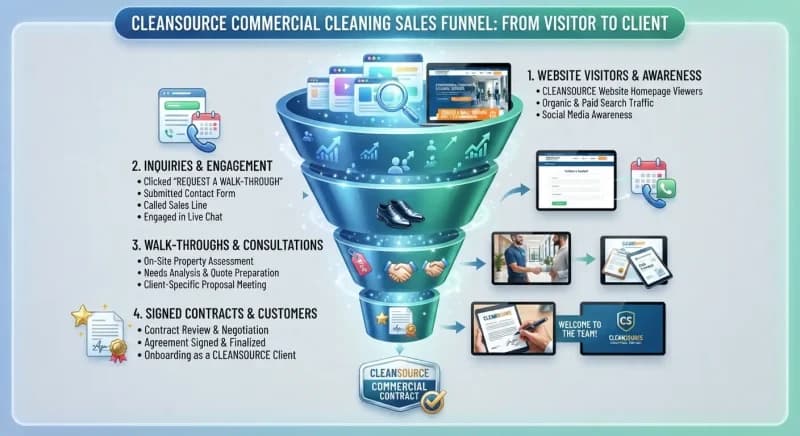
Track three numbers to judge the funnel: visits to inquiries, inquiries to walk-throughs, and walk-throughs to bids. A weak number shows which stage of the janitorial bid pipeline needs repair.
How Much Does Cleaning Business Website Design Cost?
Cleaning business website design cost depends on the build method, page count, custom features, and ongoing maintenance, not on a single flat rate. Quotes vary widely between providers, so a written scope matters more than a headline number. The table compares three common routes.
Ask every provider for a fixed scope in writing. It should list pages included, revision rounds, hosting, and who owns the domain and content. Lower-cost routes tend to trade away control over speed and structure, and higher-cost routes should be justified by commercial strategy, not only nicer visuals.
What Mistakes Do Cleaning Companies Make With Their Websites?
The most damaging mistakes are trust gaps, not ugly design. Seven come up repeatedly:
Speaking to homeowners and businesses on the same page. Commercial buyers leave when the copy sounds like a maid service.
Using generic stock photos. Photos of real crews, equipment, and buildings signal a real operation.
Hiding insurance and references. These are the first items a facility manager checks.
Using a vague "Contact Us" button. "Request a Free Walk-Through" tells the buyer exactly what happens next.
Ignoring mobile layout. Buttons that are hard to tap and text that is hard to read lose visitors quickly.
Skipping service-area pages. Without local pages, the site gives search engines little reason to show it in nearby searches.
Never updating content. A dead blog and an old copyright year suggest an inactive company.
Fixing the first three costs far less than a full rebuild and closes the biggest trust gaps. Cleaning business website design improves fastest when the audit starts with buyer trust, then moves to speed and structure.
How to Choose the Right Website Design Partner
The right partner understands commercial cleaning buyers, not only web layout. Use this checklist before signing:
Ask for examples from commercial, B2B, or service businesses, not only residential brands.
Confirm that you own the domain, hosting account, and all content.
Request mobile speed results from past projects, using a tool such as PageSpeed Insights.
Confirm the plan for Organization, LocalBusiness, or Service schema.
Ask how form submissions and phone calls will be tracked.
Get scope, timeline, and revision limits in writing.
Ask who maintains the site after launch and what that costs.
A partner who asks about your target facility types, service area, and bid process is thinking like a seller. A partner who talks only about templates and colors is not. Commercial cleaning website design starts with the buyer's decision process, and layout follows from it.
Frequently Asked Questions
What pages does a janitorial website need?
A janitorial website needs a homepage, service pages by facility type, service-area pages, an about page, a proof page with references and insurance details, and a contact page built around a walk-through request. Each page should point to one next step. A blog is useful for search traffic but comes after these core pages.
How long does it take to build a cleaning company website?
Most cleaning company websites take a few weeks to a few months to build, depending on scope. Template-based sites sit at the short end, and custom sites with many service pages take longer. A frequent delay is missing content, such as photos of real work, client references, and insurance documents.
Does a commercial cleaning company need a blog?
A blog is not required, but it helps a site earn search traffic and AI citations for buyer questions such as contract costs and bid processes. Each post should answer one specific question in plain language. A small number of accurate, updated articles is more useful than a large archive of thin posts.
What platform should a cleaning business use for its website?
No single platform fits every cleaning business. WordPress, Webflow, Wix, and custom frameworks can all work. Choose based on control over page speed, ease of editing, and who handles updates. Owning the domain and content matters more than the brand name of the builder.
Should a cleaning company website show prices?
Commercial cleaning sites usually should not list fixed prices, because cost depends on square footage, floor types, service frequency, and scope. Publishing the pricing factors instead builds trust and filters out poor-fit leads. A page explaining how quotes work, ending with a walk-through request, serves the buyer better than a rate card.
How often should a cleaning company update its website?
Review the site at least every quarter and update it whenever services, insurance, or references change. Refresh statistics, photos, and testimonials on that schedule, and show a visible last-updated date on key articles. Outdated details lower buyer trust and can give AI answer engines a reason to prefer fresher sources.
Conclusion: Build a Website That Supports Your Sales Pipeline
Cleaning company website design works when the site is built for commercial buyers: fast on mobile, full of proof, and centered on a single walk-through request. The seven core pages, the conversion elements, and the trust fixes above cover what most cleaning contractors are missing. Start with the trust signals and the call to action, then improve speed and structure.
A strong website is one half of a working sales system. Janitorial Appointment helps commercial cleaning companies fill the other half, using B2B cleaning sales outsourcing and appointment setting to put decision-makers on the calendar. Pair a site that builds trust with outreach that starts conversations, and the walk-throughs follow.
Connect With Us
Have questions? Want to learn more? Reach out to us on WhatsApp or follow us on Facebook for updates and tips.


