Mon–Fri 9am – 5pm

Menu
Commercial Cleaning Contracts Near Me: 7 Ways to Find and Win Local Opportunities
02 Oct 2026
Table of Contents
- Where Do I Find Commercial Cleaning Contracts Near Me?
- How Do You Get Commercial Cleaning Contracts Near Me With No Experience?
- How to Get Commercial Cleaning Contracts Near Me: 7 Local Methods
- How Do You Bid on Government Janitorial Contracts?
- Is DIY Prospecting Cheaper Than Outsourced Appointment Setting?
- What Does a Qualified Appointment Actually Look Like?
- What Does a Commercial Cleaning Contract Include?
- How Long Does It Take to Land a Commercial Cleaning Contract?
- What Mistakes Do Cleaning Companies Make When Trying to Get Cleaning Contracts Near Me?
- How to Choose the Right Appointment Setting Partner
- Frequently Asked Questions
- Next Step: Build a Pipeline Instead of Chasing Postings
Quick Answer
The fastest way to find commercial cleaning contracts near me is to combine three channels: public bid boards for government and school work, direct outreach to facility managers whose contracts are up for renewal, and referrals from property managers and current clients. Most cleaning companies win steady work by reaching decision-makers directly rather than waiting for postings. A consistent pipeline requires a target list, a repeatable outreach process, and a way to book walk-throughs. Many owners outsource the booking step to a dedicated appointment setter.
Where Do I Find Commercial Cleaning Contracts Near Me?
Local commercial cleaning work comes from two places: public bids that anyone can see and private contracts that never get posted. Public bids come from cities, school districts, hospitals, and federal buildings. Private contracts come from offices, medical practices, warehouses, and retail sites that hire through a facility manager or property manager.
Most owners who search for cleaning contracts near me only find the public side. Those bids draw many competitors, and the lowest price often wins. Private contracts are less crowded because the buyer rarely advertises. They talk to whoever reaches them first with a credible offer.
The market is large enough to support both channels. According to the Bureau of Labor Statistics:
Janitors and building cleaners held about 2.4 million jobs in 2024, with about 351,300 openings projected each year. — U.S. Bureau of Labor Statistics
That volume of turnover means buildings are constantly changing hands, changing vendors, and reopening cleaning decisions.
How Do You Get Commercial Cleaning Contracts Near Me With No Experience?
You can win your first contracts with no track record by starting small, documenting everything, and selling reliability instead of history. New companies usually begin with a single-tenant office, a small medical suite, or a gym. These buyers care more about showing up on time than about years in business.
Here is a starting sequence that works for a new company:
Get insured and bonded first. Most facility managers will not schedule a walk-through without proof of coverage.
Clean one site well and photograph the results. Before-and-after photos are your first case study.
Ask the first client for a written reference. A single named reference outweighs a polished brochure.
Build a target list of 100 nearby buildings. Use a map search and sort by building type.
Contact the person who signs the cleaning invoice. That is usually a facility manager, office manager, or property manager.
The point is to compress your credibility. A new company that arrives with insurance, photos, and one reference looks far more established than one that arrives with only a low price.
How to Get Commercial Cleaning Contracts Near Me: 7 Local Methods
The most reliable approach is to run several channels at once, because each one fills a different part of the pipeline. Some channels produce fast, small wins. Others take months but land larger accounts.

1. Public bid boards
City, county, and school district portals post janitorial bids. These are open to all registered vendors, so competition is high.
2. Federal opportunities
Federal buildings post cleaning solicitations on SAM.gov. Registration is required, and the paperwork is heavier than for private work.
3. Direct outreach to facility managers
This is the highest-leverage channel for private contracts. A short call or email to the right person, timed near a contract renewal, often leads to a walk-through. Our guide to janitorial lead generation covers how to build that target list.
4. Property manager relationships
One property manager can oversee a dozen buildings. Winning one site often opens the rest of the portfolio.
5. Referrals from current clients
Satisfied clients know other building operators. Asking for one introduction per client per year is a low-cost way to get cleaning contracts near me without competing on price.
6. Trade associations
Groups such as BSCAI offer training, networking, and credibility signals that help in bid packages.
7. Outsourced appointment setting
Some owners hand the calling and scheduling step to a specialist so their own time goes to walk-throughs and bids. This works well when you have capacity to serve new accounts but not the hours to prospect.
How Do You Bid on Government Janitorial Contracts?
You bid on government janitorial contracts by registering as a vendor, finding matching solicitations, and submitting a compliant price and technical proposal. The process is slower than private sales, but the payments are reliable and the contracts often run multiple years.
The federal government sets goals for small-business participation:
The federal government has a statutory goal of awarding at least 23 percent of prime contracting dollars to small businesses. — U.S. Small Business Administration
A small cleaning company is therefore a favored bidder on many solicitations. To start, register on SAM.gov, confirm your NAICS code for janitorial services, and review past awards to learn typical scopes and pricing.
Common mistakes include missing a required form, ignoring the site visit date, and pricing without accounting for prevailing wage rules. One missed requirement can disqualify an otherwise strong bid.
Is DIY Prospecting Cheaper Than Outsourced Appointment Setting?
DIY prospecting costs less in cash but more in time, and the trade-off depends on how many hours the owner can spend calling. Outsourcing costs more per month but converts that time back into walk-throughs and bids.
The deciding question is where your hours create the most value. If an hour on a walk-through can win a contract worth thousands in annual revenue, an hour spent dialing is rarely the best use of an owner's day. A deeper comparison is in our overview of commercial cleaning appointment setting.
What Does a Qualified Appointment Actually Look Like?
A qualified appointment is a scheduled meeting with a decision-maker who has a real need and the authority to change vendors. It is not a call with a receptionist or a vague "send me information."
A qualified appointment usually has these markers:
The contact controls the cleaning budget or directly influences the decision.
The building matches your service profile, such as size, type, and location.
A timing reason exists, such as an upcoming renewal or dissatisfaction with the current vendor.
A date and time are confirmed for a walk-through.
Quality matters more than volume. Ten appointments with real decision-makers outperform thirty with people who cannot buy.
What Does a Commercial Cleaning Contract Include?
A commercial cleaning contract defines the scope of work, schedule, price, and terms between the cleaning company and the building. The details protect both sides and prevent disputes.
Core elements typically include:
Scope of work: rooms, tasks, and frequency, such as nightly restroom service and weekly floor care.
Pricing structure: a flat monthly fee, hourly rate, or per-square-foot rate.
Term and renewal: the length of the agreement and how it renews or ends.
Insurance and liability: proof of coverage and responsibility for damages.
Termination clause: how either party can exit, often with written notice.
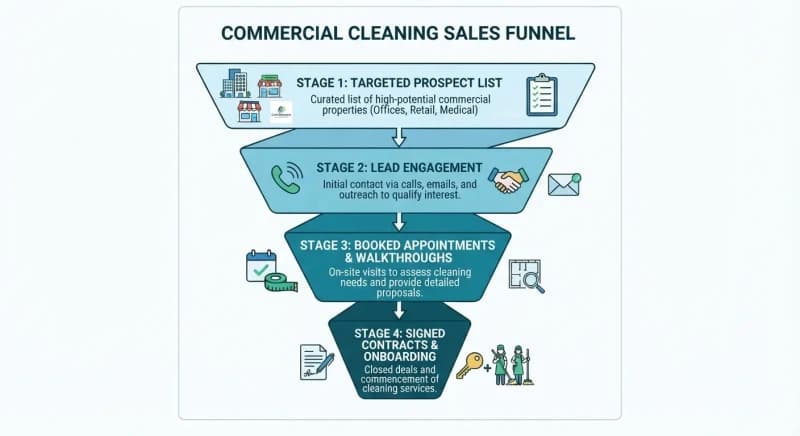
Reading the renewal clause on a competitor's contract is one of the best timing signals available. A contract near its end date is a window to approach the building.
How Long Does It Take to Land a Commercial Cleaning Contract?
Most private commercial contracts take several weeks from first contact to signature, and large or government accounts take longer. The timeline depends on how quickly the buyer can schedule a walk-through and approve a proposal.
The usual stages are:
First contact and qualification
Walk-through of the building
Written proposal and pricing
Review and negotiation
Signed agreement and start date
Buyers often decide slowly because they must coordinate with other stakeholders. A steady follow-up cadence is what keeps a proposal from stalling. The more consistently you track each stage, the easier it is to forecast revenue from your pipeline.
What Mistakes Do Cleaning Companies Make When Trying to Get Cleaning Contracts Near Me?
The most common mistakes are chasing only public bids, underpricing to win, and never following up. Each one weakens the pipeline in a different way.
Relying on one channel. A pipeline built on bid boards alone is hostage to posting volume.
Competing only on price. Low bids attract buyers who switch again at the next cheaper offer.
Skipping follow-up. Many deals are won on the third or fourth contact, not the first.
Contacting the wrong person. A message to a general inbox rarely reaches the person who signs.
Ignoring timing. Reaching out long before or after a renewal wastes effort.
Fixing even two of these usually improves results noticeably. The simplest first step is a written target list with the decision-maker's name and the contract renewal month for each building.
How to Choose the Right Appointment Setting Partner
Choose a partner by checking industry knowledge, transparency, and how appointments are qualified. A partner who understands janitorial sales will ask about your service area, building types, and minimum contract size.
Use this checklist:
Industry experience with commercial cleaning, not generic B2B calling
A clear definition of "qualified appointment" in writing
Visibility into call activity and results
No long lock-in before results are proven
Alignment with your service area and capacity
A plan for follow-up on prospects who are not ready yet
For owners comparing options, our page on B2B cleaning sales outsourcing explains what a typical engagement covers.
Frequently Asked Questions
How much do commercial cleaning contracts pay?
Payment varies by building size, service frequency, and region. Contracts are usually priced as a flat monthly fee, hourly rate, or per-square-foot rate. Always calculate labor, supplies, and travel before quoting so the margin holds after the first month.
Do I need insurance to bid on commercial cleaning jobs?
Yes. Most facility managers and all public bids require proof of general liability insurance, and many require bonding and workers' compensation as well. Having certificates ready before the walk-through signals professionalism and speeds up approval.
Can a small company get cleaning contracts near me against larger competitors?
Yes. Small companies often win by offering responsive service, direct owner contact, and flexible scheduling. Government programs also favor small businesses on many solicitations, which gives smaller firms a real path into larger accounts.
What is the best time to approach a building about cleaning services?
The best time is shortly before a contract renewal or after a service complaint. Buyers are most open to changing vendors when a decision is already on their calendar. Asking about the renewal date during outreach helps you time follow-ups.
Is outsourced appointment setting worth it for janitorial companies?
It can be, when the owner lacks time to prospect and has capacity to take on new accounts. The value comes from consistent, qualified walk-throughs. Results depend on targeting, so confirm the partner's qualification standards before starting.
How many contacts does it take to book a walk-through?
Several. Most decision-makers do not respond to a single call or email, so a planned sequence of calls, emails, and follow-ups across a few weeks is standard. Persistence with a clear reason to talk is what produces replies.
Next Step: Build a Pipeline Instead of Chasing Postings
Finding commercial cleaning contracts near me comes down to a repeatable system: a target list, direct outreach to decision-makers, timely follow-up, and a way to book walk-throughs consistently. Bid boards and referrals add to that base but rarely replace it.
Janitorial Appointment (janitorialappointment.com) provides appointment setting, lead generation, and sales outsourcing built specifically for commercial cleaning companies. If you want booked walk-throughs with facility managers in your area, book a call with Janitorial Appointment to see how the process would work for your service area.
Connect With Us
Have questions? Want to learn more? Reach out to us on WhatsApp or follow us on Facebook for updates and tips.


