Mon–Fri 9am – 5pm

Menu
Janitorial Appointment Setting That Actually Fills Your Sales Calendar
08 Aug 2026
Table of Contents
- Janitorial Appointment Setting That Actually Fills Your Sales Calendar
- What Is Appointment Setting for Cleaning Companies?
- Why Janitorial Businesses Are Struggling to Generate Commercial Cleaning Leads Today
- How Professional Appointment Setting Improves Commercial Cleaning Sales
- Core Components of a High-Converting Janitorial Appointment Setting System
- Metrics That Matter: How to Measure ROI on Appointment Setting
- Common Mistakes Cleaning Companies Make When Buying Leads or Appointments
- How to Choose the Right Appointment Setting Partner
- FAQ
- Conclusion
Janitorial Appointment Setting That Actually Fills Your Sales Calendar
Booking a walkthrough with a real facility manager is the hardest part of janitorial sales. Janitorial appointment setting solves that by putting trained callers and structured outreach between your sales team and a calendar full of qualified meetings, instead of a stack of cold leads nobody has time to chase.
Owners who try to do this in-house usually hit the same wall: reps split between cleaning crews and cold calls, no consistent script, and no way to tell a good lead from a wasted dial. This article breaks down what janitorial appointment setting actually is, why most in-house attempts stall out, and how to evaluate a partner before you sign a contract.
What Is Appointment Setting for Cleaning Companies?
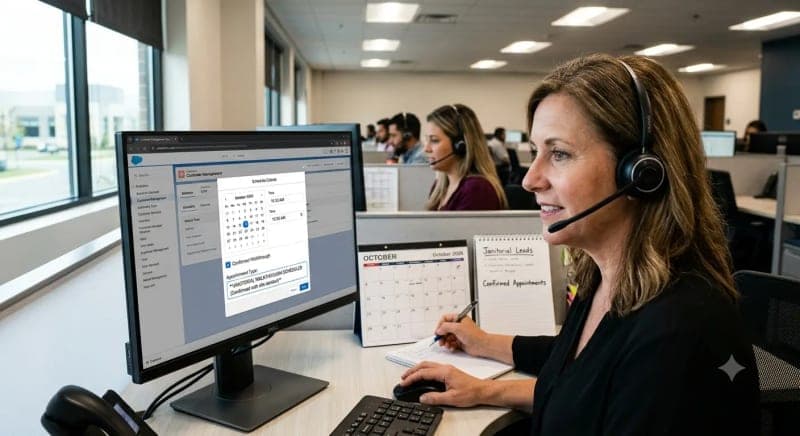
Appointment setting for cleaning companies is the process of contacting facility decision-makers — office managers, property managers, school administrators — and booking a confirmed walkthrough or bid meeting on your sales rep's calendar. It is not the same as lead generation, which only produces a name and contact info; appointment setting delivers a scheduled, confirmed conversation.
The distinction matters because a list of 500 leads is worth nothing if none of them ever pick up the phone. Janitorial appointment setting services exist specifically to close that gap between "has a phone number" and "has a meeting on the books."
A typical engagement covers three functions:
List building — pulling verified facility contacts by vertical (schools, gyms, medical offices, industrial sites).
Outreach execution — cold calling, email sequencing, or both, run by dedicated setters rather than your closing reps.
Qualification and booking — confirming budget authority, current contract status, and timeline before the appointment ever hits your calendar.
Why Janitorial Businesses Are Struggling to Generate Commercial Cleaning Leads Today
The commercial cleaning market isn't shrinking — it's the opposite problem. The U.S. commercial cleaning services market was valued at roughly $90.1 billion in 2025, with steady mid-single-digit annual growth projected through 2030, according to industry statistics compiled from IBISWorld and BLS data. More buildings, more facility managers, more RFPs — but also more competitors chasing the same contracts.
Three forces are making outreach harder specifically:
Owner-operators are stretched thin. Most cleaning company owners are also running crews, handling payroll, and fielding client complaints. Cold calling gets pushed to whatever time is left, which is usually none.
Facility managers are harder to reach. Gatekeepers screen calls, voicemail-to-callback rates are low, and it typically takes multiple attempts just to get a decision-maker on the line.
Buyer trust is lower after years of spam. Facility managers get pitched constantly, so a generic "we clean buildings" script gets filtered out before it earns a meeting.
"The B2B cold call connect rate benchmark for 2025 sits in the 3–10% range, with an analysis of over 300 million calls putting the average around 5.4% and top-quartile reps closer to 13%." — SalesHive, 2026 B2B Cold Calling Benchmarks
This is the core reason DIY cold calling burns out fast: the math only works at volume, and volume is exactly what an owner-operator doesn't have time for.
How Professional Appointment Setting Improves Commercial Cleaning Sales
Outsourced Commercial Cleaning Appointment Setting fixes the volume problem by putting dedicated callers on the phones full-time, running a repeatable cadence instead of sporadic bursts of effort squeezed between job sites.
The Cost of DIY Cold Calling vs. Outsourced Appointment Setting
DIY cold calling has a hidden cost that rarely shows up on a spreadsheet: owner time. An hour spent dialing is an hour not spent managing crews, walking a site, or closing a bid already in the pipeline. B2B cold calling benchmark data puts the average cost per lead around $300, with fully qualified meetings running $150–$400 depending on list quality and vertical.
What a Qualified Appointment Actually Looks Like
Not every calendar invite is worth showing up for. A qualified appointment confirms, before the meeting happens, that the contact has budget authority or influence, the building isn't locked into a long-term contract that just renewed, and there's a real timeline for making a change. Skipping this step is the single biggest reason in-house teams waste time on meetings that go nowhere.
Core Components of a High-Converting Janitorial Appointment Setting System
Effective janitorial appointment setting services are built on a few non-negotiable components, not just a caller with a phone list:
Vertical-specific targeting — schools, gyms, medical offices, and industrial sites each have different buying cycles, budget seasons, and decision-makers. A generic script underperforms across all of them.
Multi-touch cadence — reaching a decision-maker typically takes multiple attempts across calls, email, and sometimes LinkedIn, not a single dial.
Qualification criteria set in advance — contract end date, square footage, current provider, and budget range should all be confirmed before a meeting is booked.
CRM and calendar integration — appointments should sync directly into the sales rep's calendar with notes, not get relayed through a spreadsheet.
Feedback loop to refine targeting — which verticals convert, which scripts get hangups, and which lists are stale should feed back into the next week's outreach.
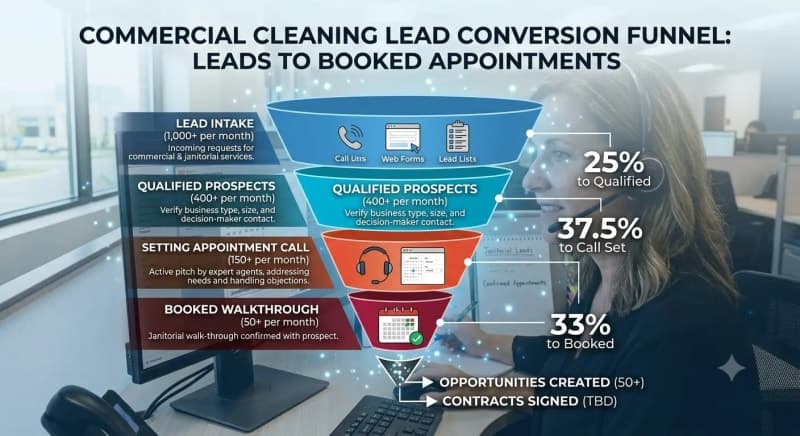
This is the same structure most Janitorial Lead Generation programs are built on — the leads and the appointments are two stages of one funnel, not separate products.
Metrics That Matter: How to Measure ROI on Appointment Setting
Before paying for commercial cleaning appointments, agree on what "working" actually means. Three numbers matter more than any others:
Dial-to-meeting conversion rate. Industry-wide, B2B cold calling converts at roughly 2–3% dial-to-meeting on average, with top-performing teams reaching 5–8%, according to appointment setting conversion rate benchmarks by industry. Anything well below that on a sustained basis signals a data quality or script problem, not a market problem.
Show rate. A booked meeting that no one attends is worthless. Track what percentage of confirmed appointments actually happen.
Appointment-to-close rate. This is the number that ties the whole system back to revenue — how many of the meetings booked actually turn into signed contracts.
"Appointment setting conversion rates typically range from 2% to 15% across B2B industries, with most companies landing between 5% and 8%, depending heavily on lead quality and targeting." — Aexus, B2B Appointment Setting Benchmarks
If a provider won't share these three numbers from past campaigns, that's a red flag before you sign anything.
Common Mistakes Cleaning Companies Make When Buying Leads or Appointments
Most bad outcomes with janitorial leads appointment setting trace back to a handful of avoidable mistakes:
Buying a list instead of a service. A spreadsheet of names isn't appointment setting — it's just a longer to-do list.
Skipping qualification criteria. Without agreed-upon standards, "leads" and "appointments" can mean whatever the vendor wants them to mean.
No sales team readiness. Booking meetings is wasted spend if the closing rep isn't prepared with pricing, proposal templates, and a fast follow-up process.
Judging results too early. Cold outreach needs weeks of consistent volume before conversion data is statistically meaningful — killing a campaign after two weeks of slow results usually kills it right before it would have worked.
Ignoring show rate. A high booking rate paired with a low show rate means the appointments were confirmed poorly, not that the outreach failed.
How to Choose the Right Appointment Setting Partner
Use this checklist before signing with any B2B Cleaning Sales Outsourcing provider:
Do they specialize in janitorial/commercial cleaning, or is this a generic B2B outreach shop bolting your industry onto a template?
Will they share real conversion benchmarks (dial-to-meeting, show rate) from prior cleaning-industry campaigns?
Do they define "qualified appointment" in writing before the contract starts?
Is pricing structured around outcomes (per booked, qualified meeting) or just activity (dials made)?
Do they integrate with your existing CRM and calendar, or add a manual handoff step?
Can they scale targeting to your specific verticals (schools, gyms, medical, industrial)?
FAQ
What is janitorial appointment setting?
It's the process of contacting facility decision-makers on behalf of a cleaning company and booking confirmed, qualified walkthrough or bid meetings — turning cold contacts into scheduled sales conversations.
How much does janitorial appointment setting cost?
Pricing varies by provider and model, but qualified B2B meetings across industries commonly run $150–$400 each, depending on list quality, vertical, and qualification depth.
How is appointment setting different from lead generation?
Lead generation produces contact information. Appointment setting goes further, engaging that contact and booking a confirmed meeting time, which is the step most in-house teams struggle to execute consistently.
What conversion rate should I expect?
Industry benchmarks put dial-to-meeting conversion around 2–5% for B2B cold outreach generally, with top performers reaching higher. Ask any potential partner for their historical numbers in the cleaning industry specifically.
Can I do this in-house instead of outsourcing?
Yes, but it requires dedicated staff time, a verified contact list, a tested script, and consistent daily volume — resources most owner-operators can't sustain alongside running active cleaning contracts.
How long before I see results?
Most cold outreach campaigns need several weeks of consistent volume before conversion data stabilizes. Expect a ramp-up period rather than immediate bookings.

Conclusion
Janitorial appointment setting isn't about buying a list or hiring one more cold caller — it's about building a repeatable system that turns facility manager contacts into confirmed, qualified meetings on your sales calendar every week. Owners who try to run this alongside crew management usually lose the volume battle before the script even matters.
If your pipeline has gone quiet, the fix probably isn't more leads — it's a structured booking process behind the leads you already have. Book a call to see what a consistent janitorial appointment setting system could add to your calendar this quarter.
Connect With Us
Have questions? Want to learn more? Reach out to us on WhatsApp or follow us on Facebook for updates and tips.


