Mon–Fri 9am – 5pm

Menu
The Ultimate Guide to Commercial Cleaning Cost Per Square Foot (2026)
Last updated:
11 Jul 2026
Table of Contents
- What Is the Average Cleaning Cost Per Square Foot in 2026?
- Office Cleaning Cost: A Closer Look
- Janitorial Hourly Rate vs. Per-Square-Foot Pricing
- 7 Factors That Influence Commercial Cleaning Prices
- How to Calculate Your Cleaning Cost Per Square Foot
- Sample Cost Breakdown by Building Size
- Common Pricing Mistakes That Cost You Clients (or Profit)
- Frequently Asked Questions
- Final Thoughts
Pricing a commercial cleaning contract is one of the hardest parts of running a janitorial business. Quote too high, and you lose the bid. Quote too low, and you work for free. This guide breaks down real 2026 numbers so you can price with confidence, whether you're building a proposal or checking your own rates against the market.
We'll cover average cleaning cost per square foot, current commercial cleaning prices by facility type, typical office cleaning cost ranges, and the janitorial hourly rate most providers charge in 2026. Every number here is backed by current industry data, not guesswork. If you'd rather skip the math and get quoting appointments booked for you, our commercial cleaning appointment setting service does that legwork on your behalf.
What Is the Average Cleaning Cost Per Square Foot in 2026?
Most commercial buildings clean for somewhere between $0.05 and $0.35 per square foot per month, though the exact number depends heavily on the type of facility. In 2026, businesses can pay anywhere from a few cents to more than a dollar per square foot depending on the building and how much traffic it sees.
Standard office space is the easiest to benchmark. Most offices fall between $0.10 and $0.18 per square foot depending on service frequency, layout, and building type. Some providers quote slightly wider ranges depending on region and scope.
Industry data point: Commercial cleaning typically costs between $0.12 and $0.35 per square foot per month, with standard offices on five-night-per-week service landing at the lower end near $0.12 to $0.18.
Here's the key takeaway for business owners: your rate should reflect the labor time your crew actually needs, not a flat industry average. A copy-paste rate that ignores restroom count, layout, and traffic will either scare off good clients or bleed your margins dry.
Commercial Cleaning Prices by Facility Type
Not all square footage is equal. A warehouse and a medical clinic of the same size need completely different labor hours, so commercial cleaning prices shift a lot by building category.
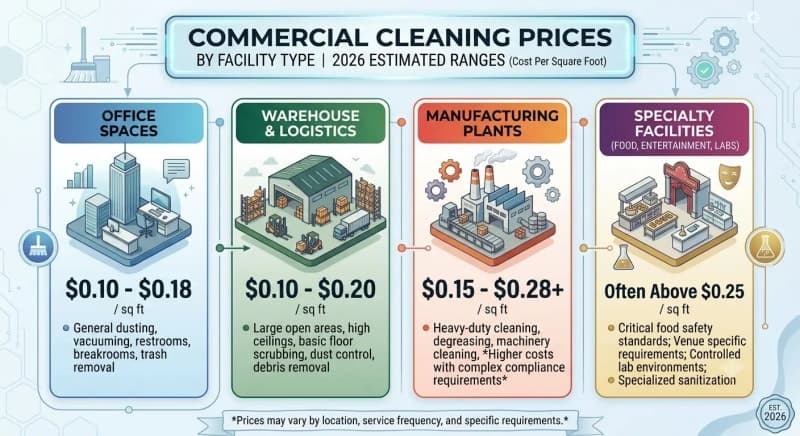
Standard offices: $0.10 to $0.18 per square foot
Warehouses and distribution centers: $0.10 to $0.20 per square foot
Manufacturing facilities: $0.15 to $0.28 per square foot, higher with compliance requirements
Medical and healthcare facilities: $0.18 to $0.30 per square foot
Specialty facilities (food processing, entertainment venues, labs): often above $0.25 per square foot
Manufacturing sites with industrial soil levels and compliance requirements typically run $0.15 to $0.28 per square foot, while specialty facilities like food processing plants exceed $0.25 because the scope of work is fundamentally more complex. This is why two buildings of identical size can have wildly different quotes — the square footage tells you the canvas, not the amount of work involved.
Office Cleaning Cost: A Closer Look
Since offices make up the bulk of recurring janitorial contracts, it's worth breaking down office cleaning cost on its own. According to Housecall Pro's 2026 commercial cleaning pricing guide, standard recurring office cleaning typically runs between $0.07 and $0.20 per square foot, while hourly rates range from $30 to $75.
For smaller offices, per-visit pricing tends to look higher on paper. Thumbtack's commercial cleaning data shows jobs commonly ranging from $120 to $880 per visit, with a national average around $370. Smaller sites carry a higher effective per-square-foot rate because travel time, setup, and minimum crew hours don't shrink along with the building.
Here's a simple example:
A 5,000-square-foot office at $0.15 per square foot costs roughly $750 per cleaning cycle.
The same office billed hourly, with two cleaners working three hours nightly, runs closer to $210 to $450 per visit, depending on local labor rates.
Bottom line for owners: always quote based on the actual task list, not just the square footage number. A 5,000-square-foot office with six restrooms and a shared kitchenette takes far longer to clean than the same footprint with two restrooms and no breakroom.
Janitorial Hourly Rate vs. Per-Square-Foot Pricing
Business owners often ask which pricing model is better: hourly or per square foot. The honest answer is that both have a place, depending on the job.
Per-square-foot pricing works best when the scope is predictable — a recurring nightly office clean, for example. Hourly pricing makes more sense for one-time jobs, irregular work, or spaces where conditions change from visit to visit.
Industry benchmark: The average hourly cost for office cleaning services varies between $35 and $75 per cleaner, while most cleaning companies in 2026 charge between $35 and $60 per hour for standard janitorial work.
The janitorial hourly rate you set needs to cover more than the technician's paycheck. Labor typically makes up roughly 50% to 70% of total job costs, so efficiency directly affects your margin. On top of wages, factor in:
Payroll taxes and workers' compensation
Supplies and equipment depreciation
Insurance and bonding — core coverage for a small commercial cleaning business typically runs about $700 per year, which should be spread across billable hours
Supervision and quality control time
Fuel, vehicle costs, and travel between sites
If your hourly rate only covers the cleaner's wage, you're not running a business — you're running a payroll pass-through.
7 Factors That Influence Commercial Cleaning Prices
According to industry pricing standards from ISSA, several variables push rates up or down, regardless of which pricing model you use.
Facility type and industry — high-traffic or high-touch environments like healthcare or education require more detailed cleaning, which increases costs
Cleaning frequency — more frequent cleaning often lowers the per-square-foot rate because crews build efficiency through routine service
Soil level and clutter — heavier buildup demands more labor per visit
Local labor market — wages and staffing availability shift pricing by region
Equipment used — HEPA vacuums and autoscrubbers raise upfront costs but often increase long-term efficiency
Scope detail — vague scopes lead to underbidding; detailed task lists produce accurate rates
Time of service — daytime cleaning generally costs more than overnight work due to staffing and disruption
Key takeaway: rate cards should never be static. Review your pricing structure at least twice a year against local wage trends and your own labor cost data.
How to Calculate Your Cleaning Cost Per Square Foot
Here's a straightforward formula you can use to build or check a quote:
Total labor hours × hourly labor cost, plus supplies and overhead, divided by total square footage = your cost per square foot.
Walk through it with real numbers:
A 10,000-square-foot office needs 6 labor hours per visit, five nights a week
Loaded labor cost (wages + taxes + insurance) is $22 per hour
Weekly labor cost: 6 hours × 5 nights × $22 = $660
Add supplies and overhead at roughly 20%: $792 per week
Divide by square footage: $792 ÷ 10,000 = $0.0792 per square foot, per weekly cycle
Multiply that out to a full month and you land in a realistic, defensible range — one you can explain line by line if a client pushes back on price.
Sample Cost Breakdown by Building Size
Here's how monthly office cleaning costs typically scale with square footage, based on standard recurring service:
Per Buildingstars' 2026 commercial cleaning cost guide, smaller commercial spaces under 1,000 square feet often run $200 to $400 per month, while spaces over 20,000 square feet frequently exceed $1,200 per month, though the per-square-foot rate itself usually drops as buildings get larger due to routing and scheduling efficiency.
How to Price Your Services Competitively
For cleaning business owners, the goal isn't matching the lowest bid in town — it's pricing a job you can actually staff, service well, and still profit from. Once your rate card is solid, pair it with a focused B2B cleaning sales outreach strategy so the right buildings actually see your quote. A few practical rules:
Never quote off square footage alone. Always walk the building or request detailed photos first.
Build in an annual escalation clause. A 3% to 4% yearly increase protects you from rising labor costs without needing to renegotiate the entire contract.
Separate periodic services from your base rate. Tasks like strip and refinish work, priced around $0.30 to $0.60 per square foot, or scrub and recoat work at $0.20 to $0.40 per square foot, should sit outside your standard monthly quote.
Price add-ons separately. Carpet cleaning, window washing, and disinfection increase deal value without forcing you to reprice your core contract.
Know your break-even hourly cost before you ever quote a job. If you don't know this number, you're guessing.
The single biggest pricing mistake business owners make is competing purely on rate. Clients rarely leave a reliable vendor over a few cents per square foot — they leave over missed visits, inconsistent quality, and vague scopes.
Common Pricing Mistakes That Cost You Clients (or Profit)
Quoting a flat monthly number with no line-item breakdown. Clients increasingly expect to see what they're paying for, and unclear pricing invites distrust.
Ignoring facility-specific soil levels. A distribution center with grease-heavy loading docks needs a different rate than a clean office suite of the same size.
Underpricing to win the bid, then cutting corners to survive. This damages your reputation faster than losing the deal would have.
Failing to review rates annually. Wage inflation moves fast, and a rate that was fair two years ago may now be a loss leader.
Frequently Asked Questions
What is the average commercial cleaning cost per square foot?
Most commercial buildings run $0.10 to $0.20 per square foot per month for standard recurring service, with healthcare and industrial facilities running higher.
Is per-square-foot or hourly pricing better for janitorial contracts?
Per-square-foot pricing works best for predictable, recurring jobs. Hourly pricing suits one-time cleans or spaces where the workload changes visit to visit.
Why do small offices sometimes cost more per square foot than large ones?
Minimum crew time, travel, and setup costs stay fixed regardless of building size, so smaller spaces carry a higher effective rate per square foot.
How often should commercial cleaning rates be reviewed?
At least once a year, and ideally tied to an escalation clause of 3% to 4% built into the original contract.
Final Thoughts
Pricing commercial cleaning contracts comes down to one principle: know your real labor cost before you know your rate. The square-foot and hourly benchmarks in this guide give you a starting point, but the winning number always comes from your own cost structure, not a generic average.
Once your pricing is dialed in, the next challenge is getting your quotes in front of the right buildings. That's where our janitorial lead generation programs come in — a steady pipeline of qualified leads makes the difference between a great rate card and a fully booked schedule.
Connect With Us
Have questions? Want to learn more? Reach out to us on WhatsApp or follow us on Facebook for updates and tips.


