Mon–Fri 9am – 5pm

Menu
Office Cleaning Cost Guide 2026: What Businesses Pay and How to Price It Right
Last updated:
11 Jul 2026
Table of Contents
- What Determines Office Cleaning Cost in 2026
- Average Office Cleaning Cost by Facility Size
- Janitorial Office Cleaning Cost vs. Standard Commercial Cleaning
- Commercial Cleaning Prices by Building Type
- Building Your Own Office Cleaning Calculator
- Contract Terms That Protect Your Margin
- Common Pricing Mistakes That Cost Cleaning Businesses Money
- Frequently Asked Questions
- Final Takeaway
If you run a janitorial or commercial cleaning company, "how much should I charge?" is the question that either builds your business or slowly bleeds it dry. Quote too high and you lose the walkthrough. Quote too low and you're staffing a contract that loses money every single month. This guide breaks down real office cleaning cost data for 2026, shows you how janitorial office cleaning cost differs by facility type, and gives you a repeatable formula — including an office cleaning calculator framework — so every bid you send out is grounded in numbers, not guesswork.
Key takeaway: Office cleaning cost isn't a single number. It's a formula built from square footage, frequency, labor, and scope — and business owners who understand that formula win more contracts at healthier margins than competitors who quote off a gut feeling.
What Determines Office Cleaning Cost in 2026
Before you can quote confidently, you need to understand the variables that move price up or down. National averages are a starting point, not a rate card — every one of these factors shifts the final number.
Square footage and layout. Open floor plans clean faster per square foot than segmented offices with private rooms, because segmentation multiplies the number of surfaces, doorways, and touchpoints per hour of labor.
Cleaning frequency. A space cleaned five nights a week isn't five times the cost of a once-a-week clean — labor and consumables scale differently than visit count, and heavier frequency often lowers the per-visit price even as the monthly total rises.
Facility type and industry. Medical offices, restaurants, and industrial facilities carry higher rates than standard corporate offices because of compliance requirements, specialized products, and additional training.
Time of service. Daytime cleaning, which requires working around active staff, typically costs more than after-hours or overnight service.
Scope of work. Basic janitorial (trash, vacuuming, restrooms, surface dusting) prices differently than add-ons like carpet extraction, strip-and-wax floor care, or high-dust warehouse racking.
Location and local labor market. Metro areas with higher minimum wage and cost of living push both hourly and per-square-foot rates upward.
Insurance, bonding, and overhead. General liability and a janitorial bond commonly run a small commercial cleaning business roughly $700 a year, and that cost has to be baked into your billable rate rather than absorbed as a loss.
Industry data point: Standard recurring office cleaning in 2026 typically runs $0.07–$0.25 per square foot, with hourly rates falling between $25 and $90, depending on facility type, region, and scope — according to Housecallpro's 2026 commercial cleaning pricing benchmarks.
Average Office Cleaning Cost by Facility Size
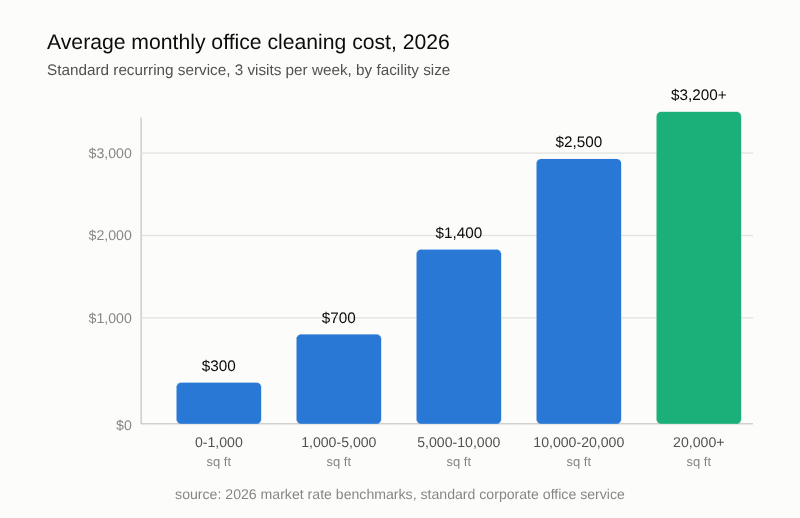
Business owners searching for office cleaning cost almost always want a dollar figure they can budget against. Here's how that typically shakes out across common office sizes, assuming standard service three times per week.
Smaller offices often see a higher per-square-foot rate because fixed labor costs — drive time, setup, minimum visit charges — don't shrink proportionally with the space. This is one of the most common pricing mistakes new cleaning business owners make: they apply a flat per-square-foot rate across all job sizes and lose money on every small account.
Janitorial Office Cleaning Cost vs. Standard Commercial Cleaning
"Janitorial" and "commercial cleaning" get used interchangeably, but property managers and business owners often mean different service levels when they say each one, and pricing your bid to match matters.
Standard commercial cleaning usually refers to recurring, scheduled service: trash removal, vacuuming, restroom sanitation, surface wiping, and basic glass cleaning at entryways.
Janitorial office cleaning cost typically includes a broader, ongoing scope — restocking consumables, floor care programs, porter services during business hours, and a dedicated account manager relationship, which is why janitorial contracts often run 10–20% higher per square foot than one-off standard cleans.
Most janitorial-level office contracts fall between $0.10 and $0.18 per square foot, with Class A office buildings sitting at the top of that range due to premium finishes and daily restroom service requirements. If you're bidding against a competitor who quoted a bare-bones standard clean at a lower rate, use this distinction to explain your number rather than dropping your price to match — explaining the scope difference wins more bids than racing to the bottom.
Commercial Cleaning Prices by Building Type
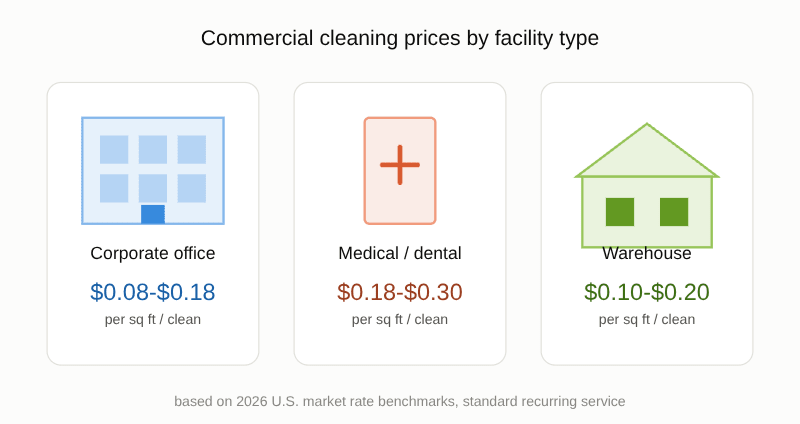
Commercial cleaning prices vary meaningfully once you move outside standard office space. Use this as a reference when a prospect asks why their medical suite or restaurant costs more than the office down the hall.
Corporate offices: $0.08–$0.18 per sq ft — the most predictable and economical clean per square foot.
Medical and dental offices: $0.18–$0.30 per sq ft — driven by EPA-registered disinfectants, compliance documentation, and daily sanitation standards.
Restaurants and food service: $0.15–$0.25+ per sq ft — kitchen hood degreasing, grease trap areas, and health code requirements add labor.
Warehouses and industrial: $0.10–$0.20 per sq ft — lower per-square-foot cost due to open floor plans, but high-dust and racking work adds time.
Retail spaces: $0.10–$0.20 per sq ft — high foot traffic and glass/display maintenance push costs above basic office rates.
Industry data point: The commercial cleaning industry is growing at roughly 7.1% annually and is projected to reach $472 billion globally in 2026, with commercial contracts making up the largest share of that revenue because they're recurring and scalable — per Fieldcamp's 2026 commercial cleaning pricing guide.
That growth is good news for cleaning business owners, but it also means more competition bidding on the same contracts. Winning consistently increasingly depends on booking qualified walkthroughs with property managers before a job ever goes out to bid, rather than competing purely on the lowest number in a stack of proposals.
Building Your Own Office Cleaning Calculator
Rate charts are a starting point, but the businesses that price profitably build their own office cleaning calculator logic rather than copying a competitor's number. Here's the formula:
Walk the building. Measure actual cleanable square footage — not gross building size — and count restrooms, break rooms, and conference spaces separately, since these take disproportionately longer to clean.
Calculate labor hours. Use a production rate (industry standard is roughly 2,500–3,500 sq ft per labor hour for standard office cleaning) to estimate time on site.
Add supply and equipment cost. Budget consumables, chemicals, and any specialty equipment as a percentage of labor cost — typically 8–12%.
Layer in overhead. Insurance, bonding, payroll taxes, and administrative cost usually add 20–30% on top of raw labor and supply cost.
Add profit margin. A healthy commercial cleaning contract should target 15–25% margin after all costs are accounted for.
Convert to a monthly flat rate. Multiply your per-visit price by monthly visit frequency, then present it as a single predictable number in your proposal.
A legitimate quote should never be a single number handed over without a walkthrough. Anyone pricing purely by square footage without walking the space is guessing, and that gap between quoted scope and actual required scope commonly runs 15% or more across audited contracts, according to Millennium Facility Services' commercial cleaning rate guide.
Contract Terms That Protect Your Margin
A price is only half the equation. The following terms should appear in every janitorial or commercial cleaning contract you sign:
Detailed scope-of-work document specifying exactly which tasks are included at which frequency.
Escalation clause — a 3–4% annual cap is standard and prevents you from absorbing rising labor costs at renewal.
Clear exclusions for specialty services like carpet extraction, strip-and-wax, or window washing, billed separately.
Defined walkthrough and verification process, especially for larger accounts where blueprints may not reflect current square footage.
Getting these terms right the first time reduces disputes later — and if your business is scaling past what your current sales process can handle, a steady pipeline of janitorial contract opportunities matters just as much as pricing accuracy, since even a perfectly priced bid is worthless without enough qualified prospects to send it to.
Common Pricing Mistakes That Cost Cleaning Businesses Money
Quoting off a competitor's number instead of your own labor and overhead costs.
Ignoring minimums on small jobs, which erodes margin on every account under 2,000 square feet.
Failing to separate janitorial-level scope from basic standard cleaning when a prospect compares your bid to a cheaper one.
Skipping the physical walkthrough, which leads to the 15%+ scope gap mentioned above.
No escalation clause, forcing you to either eat rising costs or renegotiate from a weak position at renewal.
Avoiding these five mistakes alone typically improves net margin on a commercial cleaning book of business by several percentage points within the first year.
Frequently Asked Questions
What is the average office cleaning cost per square foot in 2026?
Most standard offices fall between $0.10 and $0.18 per square foot, with a broader market range of $0.07–$0.25 depending on facility type, frequency, and region.
Is janitorial office cleaning cost higher than standard commercial cleaning?
Generally yes — janitorial contracts include broader ongoing scope like restocking and porter services, which typically pushes pricing 10–20% higher per square foot than a basic recurring clean.
How do I calculate office cleaning cost for a new bid?
Walk the space, calculate labor hours from your production rate, add supplies and overhead, then layer in a 15–25% profit margin before converting to a monthly flat rate.
Are commercial cleaning services tax deductible for the client?
Yes — cleaning services are generally considered a necessary business expense and can be deducted as an operating cost, which is worth mentioning when a prospect is weighing the investment.
Final Takeaway
Office cleaning cost in 2026 isn't a fixed number — it's a formula shaped by square footage, frequency, facility type, and scope, and the cleaning business owners who understand that formula consistently out-price and out-win competitors who quote from memory. Build your rates from real labor and overhead data, protect your margin with proper contract terms, and use commercial cleaning prices benchmarks as a sanity check rather than a rate card. Once your pricing model is solid, the next constraint on growth is almost always building a bid that wins without underpricing your margin at scale — which is where a structured proposal process and a consistent lead pipeline start to matter as much as the number itself.
Connect With Us
Have questions? Want to learn more? Reach out to us on WhatsApp or follow us on Facebook for updates and tips.


