Mon–Fri 9am – 5pm

Menu
Commercial Cleaning Marketing Strategies That Actually Book Appointments
Last updated:
13 Jul 2026
Table of Contents
- What Is Commercial Cleaning Marketing?
- Why Commercial Cleaning Sales Cycles Move Slower Than You Think
- Building a Commercial Cleaning Leads Pipeline That Doesn't Run Dry
- Cold Calling for Cleaning Companies: Does It Still Work in 2026?
- What In-House Teams Get Wrong (and How Outsourcing Fixes It)
- Appointment Setting vs. Full-Funnel Lead Generation vs. In-House Prospecting
- Measuring ROI: The Metrics That Matter
- FAQ
- Conclusion: Build a Pipeline That Doesn't Depend on Luck
Most commercial cleaning marketing advice stops at "post on social media" or "ask for referrals." That's not a strategy — it's a hope. Commercial cleaning marketing that actually works is built around one goal: getting a real facility manager or decision-maker to say yes to a walk-through. Everything else — brand awareness, website traffic, social proof — only matters if it feeds that outcome.
This guide breaks down what's actually driving booked appointments for janitorial companies in 2026, where cold calling still fits, and how to tell if outsourcing your lead generation is worth the cost.
What Is Commercial Cleaning Marketing?
Commercial cleaning marketing is the set of activities a janitorial or facility services company uses to generate qualified conversations with the people who control cleaning budgets — building owners, facility managers, and procurement teams. It is not the same as residential cleaning marketing, which relies heavily on reviews and local search.
Commercial buyers rarely make an impulse decision. They compare bids, check references, and often run a formal RFP process before signing a contract. Good commercial cleaning marketing has to work on two timelines at once: short-term (get on this quarter's bid list) and long-term (stay visible until the current vendor's contract expires).
Why Commercial Cleaning Sales Cycles Move Slower Than You Think
A homeowner might book a cleaning the same week they see an ad. A facility manager operates differently. Commercial cleaning sales cycles typically run 60 to 180 days, shaped by budget approval windows, incumbent contract terms, and internal sign-off chains that can involve three or four stakeholders.
Facility managers also buy differently than most B2B categories. They're managing risk — a bad cleaning vendor creates visible, daily complaints from tenants or employees. That means:
They weight references and existing relationships heavily.
They often wait for a walk-through before requesting a formal bid.
They rarely switch vendors mid-contract unless service has visibly failed.
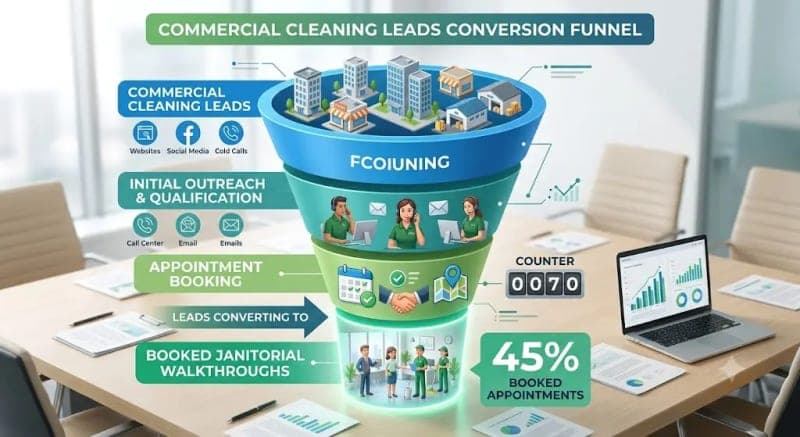
This is why appointment setting — not just lead capture — is the real bottleneck in commercial cleaning sales. A form fill on your website means nothing until someone gets that person on a calendar for a walk-through.
Building a Commercial Cleaning Leads Pipeline That Doesn't Run Dry
A pipeline built on referrals alone eventually stalls. Referrals are unpredictable and don't scale with your growth targets. A healthy commercial cleaning leads pipeline blends inbound and outbound channels so you're not dependent on any single source.
Inbound Channels Worth the Investment
Local SEO and Google Business Profile optimization — facility managers search "[city] commercial cleaning company" when an incumbent underperforms.
Case studies and vertical-specific landing pages — healthcare, education, and industrial facilities each have different compliance concerns, so generic messaging underperforms.
LinkedIn content aimed at facility managers and procurement leads — building recognition before the RFP even opens.
Outbound Channels Worth the Investment
Targeted cold email to property management companies and facility directors, segmented by building type and square footage.
Cold calling for cleaning companies, aimed specifically at buildings with contracts expiring in the next 90 to 120 days.
Direct outreach at industry trade events and local BOMA (Building Owners and Managers Association) chapter meetings, where facility managers already gather.
The industry itself is large enough to justify serious investment in pipeline-building. The U.S. janitorial services market reached an estimated $112 billion in 2026, expanding at roughly a 4.2% annual rate over the previous five years, with about one million businesses competing for that revenue. That fragmentation is exactly why differentiated outreach — not just a nice website — determines who wins the bid.
"The market size of the Janitorial Services industry in the United States is $112.0bn in 2026 across roughly one million competing businesses." — IBISWorld, 2026 Industry Report
Cold Calling for Cleaning Companies: Does It Still Work in 2026?
Yes — but not the way it worked a decade ago. Cold calling for cleaning companies still works because facility managers are reachable by phone and often prefer it to a cold email that gets buried. Research firm RAIN Group has found that a majority of senior executives across industries actually prefer phone outreach over email for a first conversation, and a large share of B2B buyers report having accepted a meeting that started as a cold call.
That said, the raw numbers are humbling if you go in unprepared. Broad B2B cold calling data puts the average dial-to-meeting conversion somewhere in the low single digits, while teams executing well — using verified contact data, a tight target list, and a clear reason for the call — post results several times higher than that baseline.
"Cognism's 2026 dataset shows the average B2B cold-call success rate climbing to roughly 2.7%, while disciplined teams working verified contact lists reach 8–13%." — Cognism, State of Cold Calling 2026
Three things separate cleaning companies that win with cold calling from those that quit after a bad week:
A tightly defined target list — buildings by size, vertical, and known contract renewal windows, not a random purchased list.
A specific reason for the call — referencing a real trigger (new ownership, visible complaints, a recent RFP posting) instead of a generic pitch.
A structured follow-up cadence — most facility managers won't commit to a walk-through on the first call, so a 5–7 touch sequence across phone and email matters more than any single script.
What In-House Teams Get Wrong (and How Outsourcing Fixes It)
Most janitorial companies don't have a dedicated sales function — the owner or operations manager handles outreach between site visits. That's the biggest reason pipelines dry up: prospecting gets deprioritized the moment operations gets busy, and operations is always busy.
Common in-house mistakes:
Inconsistent calling cadence. Outreach happens in bursts after losing a contract, then stops for months.
No tracking of contract renewal dates. Without a system, companies miss the exact window when a prospect is actually shoppable.
Owners doing the calling themselves. Founders are often the worst-fit person for high-volume prospecting — their time is better spent on bids that are already in motion.
Outsourcing appointment setting or lead generation fixes the consistency problem, but it only works if the vendor understands the janitorial bid pipeline specifically — not generic B2B sales. A vendor who doesn't know the difference between a walk-through and a signed contract will waste your calendar on unqualified meetings.
Appointment Setting vs. Full-Funnel Lead Generation vs. In-House Prospecting
Not every outsourcing option solves the same problem. Here's how the three main paths compare:
Measuring ROI: The Metrics That Matter
Before paying for any outsourced commercial cleaning marketing service, agree on what "working" means in numbers, not vibes. Track these four metrics monthly:
Cost per booked appointment — total spend divided by meetings actually held (not just scheduled).
Show rate — the percentage of booked meetings the facility manager actually attends. A low show rate usually points to weak qualification, not weak marketing.
Meeting-to-bid conversion — how many booked walk-throughs turn into a submitted proposal.
Bid-to-close rate — your existing sales close rate, which any lead gen vendor should be measured against, not blamed for.
A vendor that books meetings cheaply but produces a low show rate or low bid conversion is not actually saving you money — it's shifting the cost from marketing spend to wasted sales-team hours.
Review these numbers monthly, not quarterly. Commercial cleaning sales cycles move slowly enough that a bad channel can burn through weeks of budget before the pattern becomes obvious in quarterly reporting. Catching a falling show rate in month one — instead of month three — is usually the difference between a small correction and a wasted budget line.
FAQ
Does commercial cleaning marketing work differently than residential cleaning marketing?
Yes. Commercial buyers go through longer approval chains, formal bids, and reference checks, while residential customers often decide within days based on reviews and price.
Is cold calling for cleaning companies still worth doing in 2026?
Yes, when it's targeted at buildings with known or likely contract renewal windows and paired with a follow-up sequence — untargeted mass dialing performs far worse than segmented outreach.
How long does a typical commercial cleaning sales cycle take?
Most commercial cleaning deals take 60 to 180 days from first contact to signed contract, driven by budget cycles and incumbent contract terms.
Should a cleaning company outsource appointment setting or handle it in-house?
It depends on close rate and calendar consistency — companies that close well but struggle to keep a steady stream of qualified meetings benefit most from outsourcing.
What's a realistic cost per booked appointment for commercial cleaning leads?
Costs vary by market and vertical, but the number to watch isn't the sticker price — it's cost per appointment that actually shows up and converts to a submitted bid.
How many touches does it usually take to book a facility manager?
Most facility managers require several touches a mix of calls and follow-up emails — before committing to a walk-through, so a single cold call rarely closes the meeting on its own.
Conclusion: Build a Pipeline That Doesn't Depend on Luck
Commercial cleaning marketing succeeds or fails on one question: can you consistently get a real decision-maker on a calendar? Referrals and a nice website help, but they won't carry a growth target on their own. The companies winning more bids in 2026 are the ones treating appointment setting as a system — tracked, measured, and staffed — not an afterthought between jobs.
If your team is closing well but your calendar keeps going quiet, that's a pipeline problem, not a sales problem. Start by tracking your show rate and cost per booked appointment for 30 days before deciding whether to build this in-house or bring in outside help.
Connect With Us
Have questions? Want to learn more? Reach out to us on WhatsApp or follow us on Facebook for updates and tips.


