Mon–Fri 9am – 5pm

Menu
Best Commercial Cleaning CRM: 5 Top Picks for 2026
Last updated:
16 Sep 2026
Table of Contents
- What Is a Commercial Cleaning CRM?
- Top Commercial Cleaning CRMs Compared
- Why Commercial Cleaning Leads Fall Through the Cracks Without One
- How a CRM Improves Commercial Cleaning Sales
- Core Features to Look For in a Commercial Cleaning CRM
- Metrics That Matter: Measuring CRM ROI for a Cleaning Business
- Common Mistakes Cleaning Companies Make When Buying a CRM
- How to Choose the Right Commercial Cleaning CRM Partner
- FAQ
- Conclusion: Pick the CRM That Matches Your Bid Cycle
The best commercial cleaning CRM depends on where your sales cycle actually breaks down. For long B2B pipelines with named decision-makers and multi-month bid cycles, HubSpot CRM's free tier tracks companies and contacts at no cost. For janitorial-specific bid calculation and proposal generation, CleanGuru runs $79–$159 per month. Operators managing overnight, multi-site crews with inspection and quality-control needs often choose Swept, starting at $30 per month. Field-service teams that need routing and dispatch alongside sales tracking typically pick Jobber, starting around $27–$49 per month. Janitorial Manager offers custom-quoted pricing built around inspection workflows and work-loading. None of these replace a dedicated sales process — they organize it.
Most cleaning company owners don't lose contracts because their crews clean badly. They lose them because a lead sat in someone's inbox for four days, a follow-up never happened, or a bid renewal date got missed. At JanitorialAppointment.com, this is the gap our appointment-setting work runs straight into — a commercial cleaning CRM exists to close it, tracking every lead, quote, and contract renewal so nothing falls through the cracks. This guide compares the CRMs actually worth considering, then breaks down what a cleaning CRM needs to do and how to pick one that pays for itself in the first contract it saves.
What Is a Commercial Cleaning CRM?
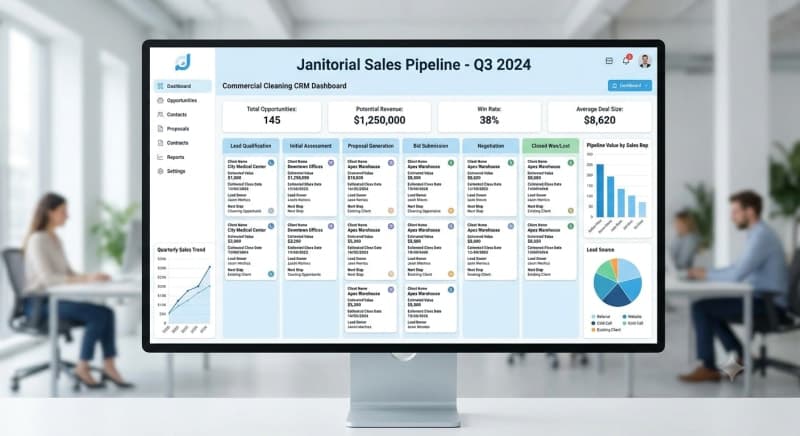
A commercial cleaning CRM is software built to track every stage of the janitorial sales cycle — from the first inquiry through the walk-through, the bid, and the signed contract — in one place. It replaces the spreadsheet-and-sticky-note system most cleaning companies start with.
Unlike a generic CRM built for SaaS or retail, a cleaning-industry CRM understands things like recurring service contracts, multi-site facility accounts, and bid renewal cycles. It should track:
Every lead source and where it entered your commercial cleaning sales pipeline
Walk-through and bid dates tied to specific facility contacts
Contract renewal windows so accounts don't quietly churn
Communication history with every facility manager, so no rep starts from zero
A good CRM doesn't just store contacts — it tells you which deal to chase today and which contract is about to expire. That distinction is what separates a working system from a digital filing cabinet.
Top Commercial Cleaning CRMs Compared
Commercial cleaning CRMs generally fall into three camps: field-service platforms built for dispatch, janitorial-specific tools built for bids and inspections, and generalist B2B CRMs built for long sales pipelines. Most operators end up needing pieces of more than one.
Jobber is built around field-service scheduling and route optimization first, sales pipeline second — a fit if your bottleneck is crew dispatch rather than bid tracking.
HubSpot CRM's free tier covers contacts, companies, and basic pipelines, which makes it a low-risk starting point for tracking a long janitorial bid cycle. Its bid-specific tools (proposals, e-signature) sit behind the paid Sales Hub.
CleanGuru is built specifically around square-foot bid calculation and proposal generation for janitorial and cleaning companies, which is where it earns its higher starting price relative to general CRMs.
Swept targets overnight, multi-language janitorial crews with geofenced clock-in, inspections, and a client portal — strong on the operational side, lighter on B2B pipeline management.
Janitorial Manager centers on inspection workflows and work-loading rather than sales-pipeline tracking, and prices custom per account rather than publishing a flat rate.
Why Commercial Cleaning Leads Fall Through the Cracks Without One
Janitorial sales cycles are longer and more fragmented than most B2B sales — a single deal can involve a cold outreach, a site walk-through, a written proposal, and a bid committee review, sometimes spanning months. Without a system tracking each stage, leads stall.
Three patterns show up again and again in cleaning companies without a real CRM:
Leads live in someone's head or inbox. When the one salesperson who "just remembers" the pipeline takes a vacation or leaves, deals go cold.
Follow-up depends on memory, not process. Facility managers juggle multiple vendors; the cleaning company that follows up consistently usually wins, not the one with the lowest bid.
Renewal dates get missed. A contract quietly lapses because no one flagged the 60-day renewal window, and a competitor picks it up.
The Commercial Cleaning Appointment Setting process only works if the leads it generates land somewhere trackable — otherwise, the appointments booked upstream get wasted downstream. This is where commercial cleaning leads actually turn into revenue or quietly die.
"Companies that use CRM systems see sales revenue rise by roughly 29% on average, alongside a 42% improvement in forecast accuracy" — industry CRM benchmark data compiled by Salesmate's 2026 CRM statistics report.
How a CRM Improves Commercial Cleaning Sales
A CRM's real value shows up in two places: how much time your team stops wasting, and how many deals stop slipping through follow-up gaps.
The Cost of a Spreadsheet vs. a Real CRM
Cleaning company owners often start with a spreadsheet because it's free. The hidden cost shows up later, in deals that never get chased and reps who spend their morning updating rows instead of calling facility managers.
What a Qualified Cleaning Lead Actually Looks Like
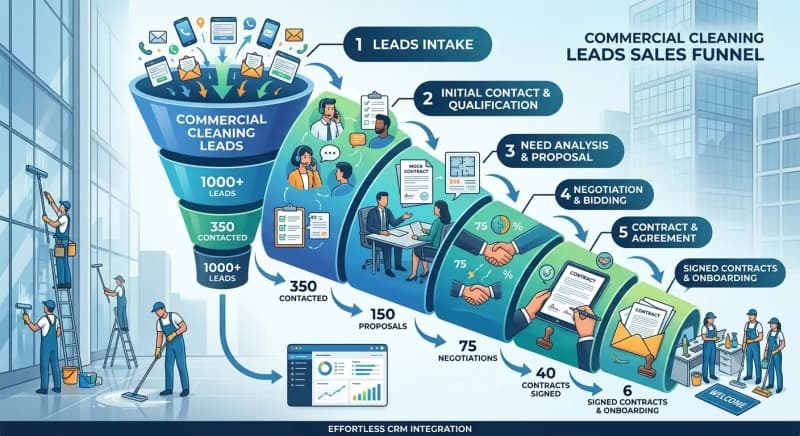
Not every phone call is worth a rep's time. A qualified lead for a janitorial company typically has:
A named decision-maker (property manager, facility director, or ownership) rather than a general inbox
A defined facility type and approximate square footage
A stated timeline — an upcoming bid cycle, an unhappy incumbent vendor, or a new facility opening
Budget signals, such as a stated per-square-foot range or prior vendor spend
A CRM lets you tag and filter leads against these criteria automatically, so reps spend time on bids they can actually win instead of chasing every inbound form fill.
Core Features to Look For in a Commercial Cleaning CRM
Not every feature marketed as "essential" actually matters for a janitorial sales team. Focus on the ones tied directly to booking and keeping contracts.
Pipeline stages built for bid cycles — inquiry, walk-through scheduled, proposal sent, bid submitted, contract signed.
Automated follow-up sequences — email and task reminders so a lead never goes more than a few days without contact.
Contract and renewal tracking — automatic alerts 60–90 days before a contract's renewal date.
Mobile access for field reps — walk-throughs happen on-site, not at a desk; reps using mobile CRM access report meaningfully higher rates of hitting sales goals.
Integration with quoting or estimating tools — so a bid moves from proposal to signature without re-entering data.
Lead source reporting — to see which commercial cleaning marketing channel (referrals, cold outreach, digital ads, RFP databases) is actually producing signed contracts.
This is the layer that turns Janitorial Lead Generation efforts into a repeatable, trackable pipeline instead of a list of names nobody follows up on.
Metrics That Matter: Measuring CRM ROI for a Cleaning Business
A CRM is a cost until you can point to the number it moved. Track these four metrics before and after implementation:
Close rate — the percentage of bids submitted that convert to signed contracts.
Average sales cycle length — time from first contact to signed agreement.
Cost per acquired contract — total sales and marketing spend divided by new contracts won.
Renewal rate — the percentage of contracts retained past their renewal date.
"Businesses adopting CRM software report an average return of $8.71 for every $1 spent, one of the highest documented ROI figures among common business software categories" — Nucleus Research, cited across multiple independent 2026 CRM industry benchmark reports.
For a mid-size cleaning company, even a modest bump in close rate or renewal rate covers the cost of most CRM platforms within a single contract cycle. Renewal tracking alone often pays for the software, since losing one $30,000–$50,000 annual contract to a missed renewal date costs more than a year of CRM subscription fees.
Common Mistakes Cleaning Companies Make When Buying a CRM
Most CRM failures aren't about the software — they're about how it gets rolled out.
Buying a generic CRM with no cleaning-industry workflow. Reps end up building bid stages and renewal fields from scratch, which usually means they never get built.
Skipping data migration. Old contacts and contract dates stay in a spreadsheet nobody opens again, so the CRM launches half-empty.
No mandatory adoption policy. Reports across the CRM industry put implementation failure due to poor team adoption at roughly 43%, almost always because logging activity wasn't made part of the actual sales process.
Ignoring mobile use. If a rep can't log a walk-through from their phone in the parking lot, they won't log it at all.
Buying more seats or features than the sales team will use. Oversized plans get abandoned faster than lean ones.
How to Choose the Right Commercial Cleaning CRM Partner
Use this checklist when evaluating vendors:
Does it support bid-cycle-specific pipeline stages out of the box?
Can it track multi-site facility accounts under one parent record?
Does it send automated contract renewal alerts?
Is there a functional, full-featured mobile app for field reps?
Does it integrate with your quoting, estimating, or accounting software?
What does onboarding and data migration actually include — is it hands-on or self-serve?
Is pricing per-seat, and does it scale reasonably as your sales team grows?
Can you get references from other janitorial or facility-services companies using it?
If you'd rather not manage the sales process yourself, B2B Cleaning Sales Outsourcing partners can run the CRM and the outreach together — but even then, you want visibility into the same pipeline data, not a black box.

FAQ
Is a generic CRM like a basic contact manager good enough for a cleaning company?
It can work for a very small operation, but it won't track bid cycles, walk-throughs, or renewal dates well. Once you're managing more than a handful of accounts, a cleaning-specific workflow saves real time.
How much should a small cleaning company expect to pay for a CRM?
Monthly CRM costs for small businesses commonly run in the range of $20–$75 per user, though many providers offer lower-tier or freemium plans for very small teams.
Can a CRM help with commercial cleaning marketing, not just sales?
Yes. Lead source tracking shows which marketing channels — referrals, cold outreach, RFP databases, digital ads — actually convert into signed contracts, so you can spend marketing budget where it works.
How long does it take to see ROI from a cleaning CRM?
Most businesses report positive returns within about 12 months of full implementation, though renewal-tracking savings can show up as soon as the first prevented missed renewal.
Does a CRM replace the need for a dedicated salesperson?
No. It supports the salesperson by tracking follow-ups, renewals, and pipeline stages — the CRM organizes the work, but someone still has to make the calls and walk the facility.
What's the biggest reason cleaning companies abandon their CRM?
Poor team adoption, not the software itself. If logging a walk-through or bid isn't a required step in the sales process, most reps stop using it within a few months.
Conclusion: Pick the CRM That Matches Your Bid Cycle
The best commercial cleaning CRM isn't the one with the most features — it's the one your sales team will actually use every day, built around how janitorial bids, walk-throughs, and renewals really work. Start with the checklist above, get a demo focused on your actual bid cycle instead of a generic sales pitch, and ask any vendor to show you exactly how contract renewal alerts work before you sign.
Ready to see how a cleaning-specific CRM could fit your pipeline? Book a walkthrough with a team that understands janitorial bid cycles, not just generic sales software.
Connect With Us
Have questions? Want to learn more? Reach out to us on WhatsApp or follow us on Facebook for updates and tips.


