Mon–Fri 9am – 5pm

Menu
The Ultimate Guide to the Commercial Cleaning Calculator
Last updated:
11 Jul 2026
Table of Contents
- What Is a Commercial Cleaning Calculator?
- How a Commercial Cleaning Estimate Calculator Works, Step by Step
- Commercial Cleaning Quote Calculator vs. Estimate Calculator: What's the Difference?
- Commercial Cleaning Cost Calculator:
- Common Mistakes That Sink Cleaning Bids
- Frequently Asked Questions
- Final Takeaway
Pricing a commercial cleaning contract by gut feeling is one of the fastest ways to lose money on a job you thought you'd won. A commercial cleaning calculator takes the guesswork out of bidding by turning square footage, service frequency, labor rates, and supply costs into a defensible number you can stand behind in a proposal meeting.
This guide breaks down exactly how a commercial cleaning calculator works, how to build or use one correctly, and how to translate the output into estimates and quotes that win contracts without eating your margin.
What Is a Commercial Cleaning Calculator?
A commercial cleaning calculator is a pricing tool — spreadsheet, web app, or software module — that converts job-specific inputs into a recommended price. Instead of pricing from memory or copying a competitor's rate card, you feed the tool real variables specific to that facility.
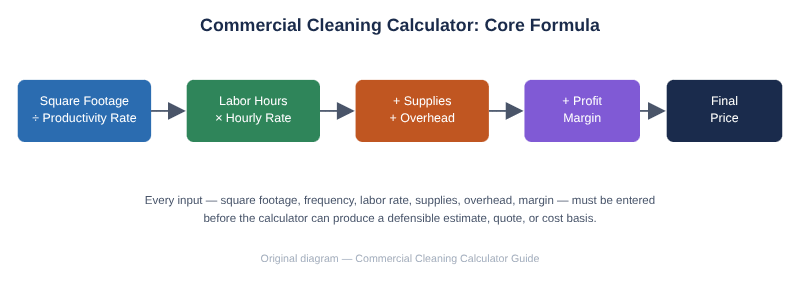
Most calculators use some version of this core formula:
(Square Footage ÷ Productivity Rate) × Labor Cost per Hour + Supplies + Overhead + Profit Margin = Final Price
The output can serve three distinct but related purposes, which is why you'll see the term used in slightly different ways across the industry:
A commercial cleaning estimate calculator gives a rough, fast number for initial conversations
A commercial cleaning quote calculator produces a formal, itemized figure tied to a specific scope of work
A commercial cleaning cost calculator focuses on your internal cost basis — what the job actually costs you to deliver, before markup
Understanding which of these three you need at each stage of the sales process is what separates operators who price confidently from those who chase their tail on every bid.
Industry data point: According to ISSA, the global cleaning industry generates over $400 billion in annual revenue, yet a significant share of janitorial companies still underprice contracts due to inconsistent estimating methods.
Why Accurate Estimating Matters More Than Ever
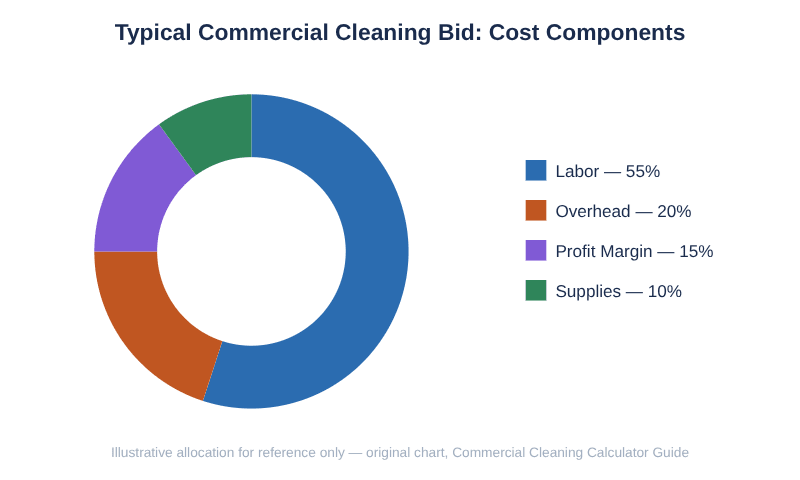
Labor is the single largest cost driver in commercial cleaning, typically consuming 50-60% of total job cost. When your calculator underestimates labor hours by even 10%, that error compounds across every cleaning cycle for the life of the contract.
A calculator forces consistency. Every estimator on your team, whether it's you or a new sales hire, plugs numbers into the same formula and arrives at a price built on the same assumptions. This eliminates the wide pricing swings that come from different people "eyeballing" the same square footage.
Consistency also protects you during contract renewals. If a client asks why their price is increasing, you can point to specific inputs — added square footage, increased frequency, higher supply costs — rather than defending a number you can't fully explain.
Key Variables Every Commercial Cleaning Calculator Needs
A calculator is only as good as the variables you build into it. At minimum, your tool should account for the following inputs.
Total cleanable square footage — excluding areas not serviced, like mechanical rooms or storage
Facility type — office, medical, retail, industrial, and educational spaces all have different productivity rates and compliance requirements
Cleaning frequency — nightly, weekly, or specific days per week directly multiplies your labor hours
Productivity rate — square feet cleaned per labor hour, which varies by task type and flooring
Labor cost — wages, payroll taxes, workers' comp, and any prevailing wage requirements
Supplies and consumables — paper products, chemicals, equipment depreciation
Travel and drive time — especially relevant for multi-site janitorial contracts
Overhead allocation — insurance, management, office costs spread across active contracts
Target profit margin — typically 10-20% for janitorial services depending on contract size and risk
Skipping even one of these categories is how bids that look profitable on paper turn into break-even or losing contracts once the crew starts working.
How a Commercial Cleaning Estimate Calculator Works, Step by Step
An estimate calculator is designed for speed. You use it during a discovery call or initial site walk, before you have the full scope locked in.
Step 1: Capture the basics. Get square footage, facility type, and desired frequency directly from the prospect or a quick walkthrough.
Step 2: Apply a productivity rate. Standard office space typically runs 2,500-3,500 square feet per hour for general cleaning; medical and food service facilities run significantly lower due to sanitation requirements.
Step 3: Calculate labor hours. Divide total square footage by the productivity rate to get hours per cleaning visit, then multiply by visits per month.
Step 4: Layer in cost per hour. Multiply labor hours by your fully burdened labor rate — wages plus taxes, insurance, and benefits.
Step 5: Add supplies and overhead. A common shortcut is applying supplies at 3-5% of labor cost and overhead at 15-20%, adjusted based on your actual financials.
Step 6: Apply margin. Add your target profit percentage to arrive at the estimate range you'll present verbally or in a follow-up email.
This process should take minutes, not hours. If your estimating process requires a full day of manual calculation, the calculator itself needs rebuilding.
Commercial Cleaning Quote Calculator vs. Estimate Calculator: What's the Difference?
People use these terms interchangeably, but treating them as identical stages costs businesses money. An estimate is a starting conversation. A quote is a commitment.
A commercial cleaning quote calculator should incorporate a completed site walkthrough, confirmed frequency, and any special requirements — floor care, window cleaning, disinfection protocols — before the number goes into a signed proposal. This is also the stage where you should clarify contract terms, since a quote that becomes a contract needs language covering scope changes, holidays, and price escalation clauses.
Industry benchmark: Janitorial contracts with clearly itemized scope-of-work documentation see meaningfully lower dispute and cancellation rates than contracts priced with a single lump-sum number, according to reporting compiled by building service contractor associations.
Commercial Cleaning Cost Calculator:
Understanding Your True Cost Basis
Before you can price a job profitably, you need to know what it actually costs you to deliver — separate from what you charge the client. This is the function of a commercial cleaning cost calculator, and it's the tool most new business owners skip.
Your true cost basis includes:
Direct labor — wages plus employer-side payroll tax burden, typically adding 10-15% on top of gross wages
Workers' compensation insurance — varies significantly by state and classification code
General liability insurance — often allocated as a percentage of revenue
Equipment costs — vacuums, floor machines, and their maintenance and depreciation schedules
Chemical and consumable costs — which can swing significantly with paper product and chemical inflation
Management and supervision time — quality control visits, scheduling, and client communication
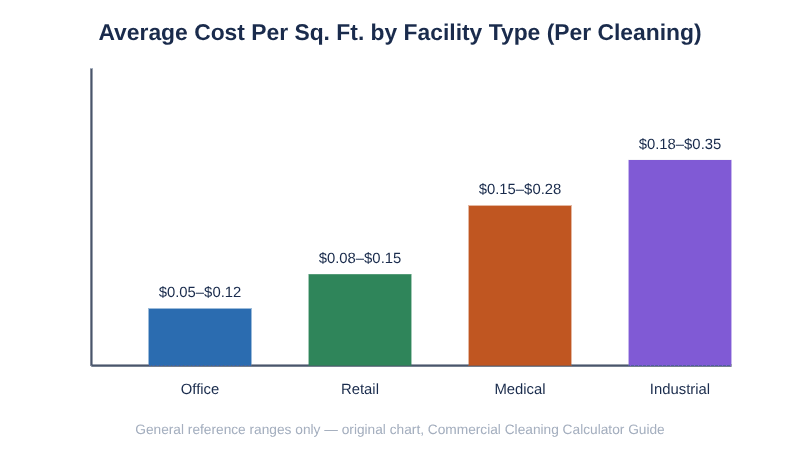
National average commercial cleaning costs generally range from $0.05 to $0.20 per square foot per cleaning for standard office space, with medical, industrial, and specialty floor care running considerably higher. These figures are starting reference points, not pricing rules — your local labor market and specific overhead structure will move your real numbers.
Common Mistakes That Sink Cleaning Bids
Even with a calculator in hand, certain habits consistently produce inaccurate pricing.
Using a single flat productivity rate for every facility type rather than adjusting for medical, industrial, or retail environments
Forgetting travel time between buildings on multi-site contracts
Underestimating supply consumption for high-traffic restrooms or food service areas
Failing to build in a price escalation clause for multi-year contracts, leaving you locked into rising labor costs
Quoting from a walkthrough alone without confirming frequency and task list in writing before finalizing the number
very one of these mistakes is preventable with a calculator that forces you to enter the variable before it lets you generate a price. A well-built tool acts as a checklist as much as a math engine.
From Calculator Output to Closed Contract
A calculator only creates value once its output turns into a signed agreement. Once your number is generated, present it inside a clear, itemized proposal rather than a single total — clients respond better to transparency about what they're paying for, whether that's nightly office cleaning, weekly floor care, or monthly deep cleaning add-ons.
If your pipeline of prospects to run through the calculator is thin, that's a separate but connected problem. Many janitorial companies pair their pricing tools with source verified prospects through our Janitorial Lead Generation Lead Lists to keep a steady stream of facilities to quote.
Once a prospect is warm, getting the walkthrough scheduled is often the biggest bottleneck — this is where companies book more walkthroughs with done-for-you Commercial Cleaning Appointment Setting to keep estimators focused on pricing instead of cold outreach.
And when it's time to turn your calculator's number into a client-facing document, don't build a proposal from scratch every time — teams that close faster because the document itself reinforces professionalism and scope clarity.
Frequently Asked Questions
How accurate is a commercial cleaning calculator compared to a manual bid?
A properly configured calculator is generally more accurate than manual estimating because it applies consistent productivity rates and cost inputs every time, removing the variability of different estimators making different assumptions.
Should I charge per square foot or per hour?
Most commercial contracts are priced per square foot for standardized recurring services, while specialty or one-time projects like post-construction cleanup are often priced per hour or per project scope.
How often should I update my calculator's inputs?
Review labor rates, insurance costs, and supply pricing at least twice a year, and immediately after any minimum wage change in your operating region.
Can one calculator work for both office and industrial cleaning?
Not accurately. Productivity rates and safety/compliance requirements differ enough between facility types that your calculator should include separate productivity settings for each category you service.
Final Takeaway
A commercial cleaning calculator isn't just a pricing convenience — it's the foundation of a profitable, scalable janitorial business. Whether you're generating a fast estimate on a discovery call, building a formal quote for a signature, or auditing your true cost basis before renewal season, the discipline of calculating rather than guessing is what protects your margin on every contract you win.
Connect With Us
Have questions? Want to learn more? Reach out to us on WhatsApp or follow us on Facebook for updates and tips.


