Mon–Fri 9am – 5pm

Menu
School Cleaning Contracts Near Me: Opportunities & Bidding Tips
Last updated:
26 Oct 2026
Table of Contents
- What Are School Cleaning Contracts?
- Why Cleaning Companies Struggle to Find Open Cleaning Contracts Near Me Today
- Where to Find School Cleaning Contracts Near Me
- What Districts Look For: Core Components of a Winning School Bid
- Metrics That Matter: Which Cleaning Contracts Near Me Are Worth Bidding?
- Common Mistakes Cleaning Companies Make on School Bids
- How to Balance Public Bids With Direct Outreach (and Choose the Right Partner)
- FAQ: School and Government Cleaning Contracts
- Conclusion: Your Next Step Toward School Cleaning Contracts
Searching for school cleaning contracts near me usually leads to a maze of bid portals, PDF packets, and deadlines. Schools are a strong market for commercial cleaners because the buildings are large, the work repeats every night, and contracts often run for several years. But districts buy differently from office managers, and one missed pre-bid meeting can end your chance.
This guide shows where to find school and government cleaning bids, how the process works, and which mistakes cost cleaning companies awards. It also shows how to build a pipeline that does not depend on one bid cycle.
What Are School Cleaning Contracts?
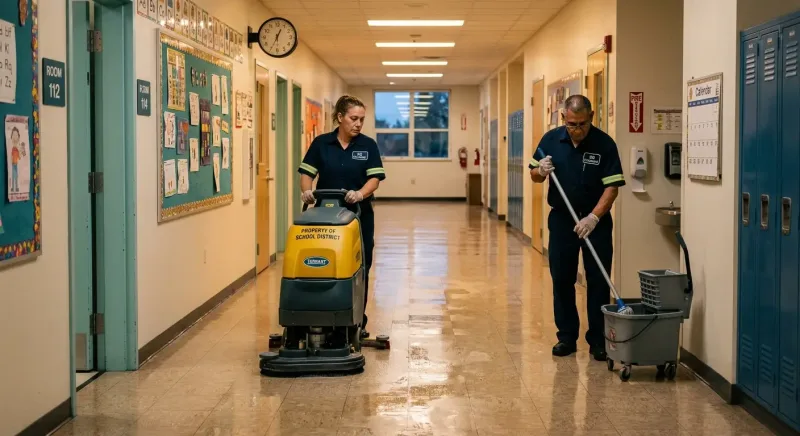
School cleaning contracts are agreements where a district, charter network, or private school pays an outside company to clean its buildings on a set schedule. Most cover nightly custodial work, restrooms, floors, trash removal, and summer deep cleaning. Terms commonly run one to three years, with renewal options.
Some schools outsource all cleaning. Others keep their own custodians and hire a contractor for certain buildings, shifts, or summer projects. That split changes the scope you price, so read it first.
The buyer pool is large, and every building in it needs clean floors, restrooms, and classrooms.
Stat: The National Center for Education Statistics counted 98,609 public schools in operation in 2020–21, as reported by American School & University.
Charter and private schools add more buyers on top of that.
Who signs the contract? Usually a business official, facilities director, or purchasing officer, with board approval for larger awards. Knowing that title before you reach out saves weeks.
Why Cleaning Companies Struggle to Find Open Cleaning Contracts Near Me Today
Searching for open cleaning contracts near me is hard because no single list exists. That is especially true for school cleaning contracts near me, which sit on district websites, state portals, city sites, SAM.gov, and paid bid boards. A bid that closes in three weeks is easy to miss. One Arizona elementary district, for example, posted a districtwide custodial RFP on May 8, 2026, with a June 1 due date, according to a public bid listing.
Budgets add pressure.
Brookings reports that the end of pandemic relief funding left districts dealing with budget cuts and staffing strain. Some boards are weighing outsourcing to save money. New Jersey’s Pascack Valley Regional High School District said its board was considering outsourcing custodial services among its cost-saving measures for the 2026–27 budget.
Demand is uneven, though. When Palominas Elementary received outsourcing proposals, the superintendent reported they came in much higher than expected, so the district kept custodial work in-house, per Civic IQ. A contract can appear and vanish inside one budget cycle.
Competition is heavy too. The NAICS Association lists nearly 100,000 janitorial businesses, and IBISWorld puts 2026 U.S. janitorial revenue at about $112 billion.
Where to Find School Cleaning Contracts Near Me
Start with the buyers closest to you, then widen the search. Open cleaning contracts near me change weekly, so a steady alert system beats an occasional search.
Public Districts, Charter Schools, and Private Schools
District websites: Look under Purchasing, Business Services, or Bids and RFPs, and sign up for email alerts.
State procurement portals: Many states list school and municipal bids in one place.
School board agendas: Budget talks and custodial agenda items often signal a coming RFP.
Charter networks and private schools: These buyers may decide faster, and their rules vary by state. Reach the operations director or head of school directly.
Fall bids exist too. In October 2026, the Town of Hadley, Massachusetts sought a contractor for two public school buildings on a three-year term, according to a public bid listing.
Government Cleaning Contracts Near Me: Federal, State, and Local Portals
Government cleaning contracts near me can include courthouses, libraries, city halls, and federal buildings. Federal janitorial work is posted on SAM.gov under NAICS code 561720, and you must register there before you can win a federal award.
Stat: A July 2026 USDA NRCS janitorial solicitation listed a $22 million small business size standard for NAICS 561720 and set the work aside for small businesses, per Govly’s public listing.
Most janitorial firms fall under that cap, so small-business set-asides are open to them. Confirm the current number in the SBA size standards guide before you bid.
Wage rules differ by buyer. Federal service contracts over $2,500 must follow Department of Labor wage determinations, according to the DOL’s Service Contract Act overview, which lists janitorial work as an example. State and local contracts follow state and local wage rules, so check each solicitation.
What Districts Look For: Core Components of a Winning School Bid
Districts score more than price. Many RFPs weigh experience, references, staffing, and quality control. Build your proposal around these seven parts:
Attend the pre-bid meeting. Some districts make it mandatory. Van Dyke Public Schools in Michigan, for example, listed a mandatory pre-bid meeting on its 2026 custodial RFP.
Measure the work. Walk the buildings and note square footage, floor types, restroom counts, and shift windows.
Price from labor up. Add wages, payroll taxes, insurance, supplies, equipment, supervision, and margin. Use the written Q&A period to ask about current staffing and hours.
Show a quality control plan. Describe inspections, checklists, response times, and how you handle complaints.
Prove safety and compliance. Include insurance certificates, background-check procedures, and product choices that match EPA’s school indoor air quality guidance.
Bring references. Use school, college, daycare, or large commercial references. Standards and groups such as ISSA and BSCAI give you credible names to cite.
Plan the transition. Cover your start date, key control, summer deep cleaning, and, where rules allow, how you will treat current custodial staff.
Health is part of the scoring mindset, not just price.
Stat: About one fifth of the U.S. population spends time in a school every school day, notes the Indiana Department of Health’s indoor air quality manual.
Proposals that address dust, moisture, and safer products give evaluators a reason to trust you.
Metrics That Matter: Which Cleaning Contracts Near Me Are Worth Bidding?
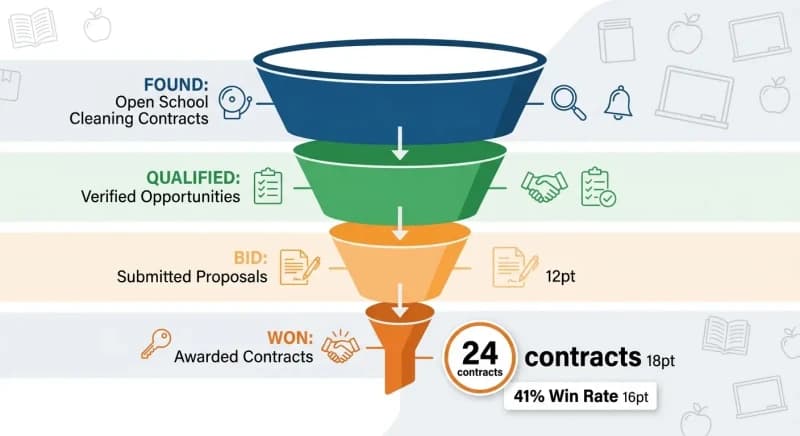
Not all cleaning contracts near me deserve a bid. Every proposal costs hours, so track what each one returns. Four numbers do most of the work:
Win rate: awards divided by bids submitted. Two wins from 12 bids is a 16.7% win rate.
Hours per proposal: the time your team spends reading, walking sites, pricing, and writing.
Gross margin per labor hour: what you keep after wages, taxes, supplies, and supervision.
Pipeline coverage: qualified opportunities in view compared with your revenue goal.
Here is why hours per proposal matter. Say a proposal takes 15 hours of staff time at a loaded cost of $40 an hour. That is $600 per bid.
At a 16.7% win rate, you spend about $3,600 in proposal time for every award. This is an illustration, not an industry benchmark, so plug in your own numbers.
Then add a simple bid or no-bid screen with three questions:
Can your crew cover the scope and the shift window?
Can you pass the insurance and screening rules?
Does your margin survive the required wages?
If two answers are no, skip the bid and spend those hours elsewhere. A short list of strong bids usually beats a long list of weak ones.
Common Mistakes Cleaning Companies Make on School Bids
Most lost bids on school cleaning contracts near me trace back to a few repeat errors. Fixing them costs little and can lift your win rate.
Missing the pre-bid meeting. If it is mandatory, you may be out before you start.
Pricing below required wages. Winning a contract that costs more to staff than it pays is a loss with a signature on it.
Ignoring the district’s budget reality. Palominas closed its outsourcing RFP after proposals came in higher than expected. Use the Q&A period to learn the current staffing picture, then explain the value behind your price.
Overlooking summer work. Deep cleaning and floor projects were part of that district’s scope, and they often shape your labor plan.
Thin proof. No quality control plan or weak references makes evaluators nervous.
Betting everything on one bid. Awards can be delayed or canceled, so one bid should never carry your year.
None of these mistakes needs special talent to fix. They need a checklist, a calendar, and the habit of reading the whole packet before you price it.
How to Balance Public Bids With Direct Outreach (and Choose the Right Partner)
Public bids for school cleaning contracts near me are slow, and some never reach an award. A healthy pipeline mixes bids with direct outreach to private schools, charter operators, colleges, daycare chains, and nearby commercial buildings. Those buyers often start with a walk-through and a conversation.
That is where commercial cleaning appointment setting helps. A trained setter reaches the facility manager or operations director, confirms the need, and books a walk-through for your sales rep. Pair it with janitorial lead generation so your calendar fills while your bid team works the portals.
Use this checklist when you compare B2B cleaning sales outsourcing partners:
Janitorial knowledge: They understand walk-throughs, bid cycles, and facility manager buying habits.
Decision-maker targeting: They reach facilities directors and operations managers by title.
Appointments, not just leads: They book meetings, not only send contact lists.
A clear definition of “qualified”: Scope, timeline, and decision-maker are confirmed before you drive out.
Reporting: You see show rate, appointment-to-bid rate, and bid-to-win rate.
Compliance: They follow do-not-call and email rules.
FAQ: School and Government Cleaning Contracts
How do I find school cleaning contracts near me?
Check your local district’s purchasing page, your state procurement portal, and school board agendas, then set email alerts. Add charter networks and private schools to your list. Search the district name plus “custodial RFP” each winter and spring, when many July 1 starts go out for bid.
Where can I find government cleaning contracts near me?
Search SAM.gov for federal janitorial work under NAICS 561720, then check state, county, and city portals. Libraries, courthouses, and city halls post their own bids. Register on each portal you plan to use so you receive alerts and can submit quickly.
Do I need SAM.gov registration to bid on school contracts?
Not usually for local school district bids, but you do for federal contracts. Districts follow their own purchasing rules, so read each solicitation. SAM.gov registration is free, and having it ready keeps federal work open if you decide to pursue it later.
When do school districts post cleaning bids?
Many post from winter through late spring for contracts that start July 1, but off-cycle bids appear all year. Public bid listings from 2026 show custodial RFPs in January, February, May, and October. Watch board agendas to spot them earlier.
Can a new cleaning company win a school contract?
Yes, but expect to prove experience, insurance, and a quality control plan. New firms often start with charter schools, private schools, or smaller districts, or subcontract to an established contractor. Use commercial references to show you can staff and supervise recurring work.
Do school cleaning contracts require background checks?
Many districts require background checks for contractor staff who work in buildings with students, but rules vary by state and district. Read the RFP’s security section and ask in the Q&A period. Build screening costs and onboarding time into your price.
Conclusion: Your Next Step Toward School Cleaning Contracts
School cleaning contracts near me reward companies that prepare early. The work is steady, the buildings are large, and many districts rebid on a regular cycle. Preparation is the part you control.
Take three steps this month:
Set bid alerts for your district, your state portal, and SAM.gov, so open cleaning contracts near me reach your inbox.
Build a ready-to-send kit with insurance certificates, references, a quality control plan, and a screening process.
Score every bid against your win rate, hours, and margin before you commit.
Then add a second engine. Government cleaning contracts near me and school bids take time, and a calendar full of walk-throughs with private buyers keeps your sales pipeline moving in the meantime. If you want booked meetings with decision-makers while you chase public bids, talk to our team about commercial cleaning appointment setting.
Connect With Us
Have questions? Want to learn more? Reach out to us on WhatsApp or follow us on Facebook for updates and tips.


